An extraordinary 18.5 kilograms of silver has been discovered at Rebild, making it the largest known Viking-Age silver hoard in Denmark. The find is almost three times larger than what was previously the country’s largest Viking-Age silver hoard, the Terslev Hoard, which weighs approximately 6.5 kilograms.
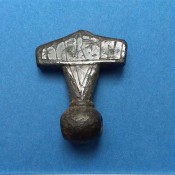
The newly discovered hoard was deposited in a clay vessel sometime during the 10th century and consists of around 700 objects and fragments. In addition to numerous silver ingots, it contains bracelets, 47 complete and fragmentary coins, a small Thor’s hammer and various pieces of cut silver.
New terrace leads to discovery
The hoard came to light during work to build a new terrace in a private garden in Rebild.
“It was only supposed to be a few hours of hard gardening work, removing stubborn grass, stones and gravel to make way for a new paved terrace, but it turned into the biggest surprise of my life,” said the finder of the silver hoard, who wishes to remain anonymous.
“After half an hour of digging, my garden fork struck something that made a strange sound. At first, I thought it was old iron or fencing wire and some pottery sherds, but when I started digging with my hands, I suddenly began pulling one metal object after another out of the ground. After carefully working for a short while, I realised that they were jewellery, coins and silver ingots.”
Around 320 objects, with a combined weight of 6.4 kilograms, remained inside the original clay vessel, while the rest were recovered from the surrounding soil.
Torben Sarauw, archaeologist and head of cultural heritage at the North Jutland Museums, described the find as both spectacular and unique.
“This is a find of enormous importance for our understanding of the Viking Age in Denmark. Not only because of its size, but also because the hoard demonstrates so clearly how silver functioned both as wealth and as a means of payment during the Viking Age. It is like finding a safe from the Viking Age,” Sarauw said.
The hoard also contains an intriguing clue: one of the silver ingots bears a runic inscription. The inscription can possibly be read as “hutu” and may represent a name, an ownership mark or another form of meaningful marking.
Silver valued by weight
According to Sarauw, the newly discovered Rebild hoard is particularly interesting because it is dominated by ingots, jewellery and pieces of cut silver, while coins account for only a very small proportion of its total weight. It therefore provides a rare insight into how wealth could be stored, organised and concealed in Viking-Age Denmark.
“When we analyse the weight of the silver objects, the hoard provides information about economic practices during the Viking Age. It does not consist simply of beautiful objects. Most of the pieces formed part of a structured system of value based on weight,” he said.
Silver ingots, jewellery and scrap silver could be used both as a means of payment and as a store of value, with the weight of the metal being crucial. Silver was therefore frequently cut into smaller pieces, divided or melted down.
The unusually large number of silver ingots in the hoard fall into specific weight groups, as do parts of the bracelets and pieces of scrap silver. This suggests that the silver was not assembled randomly but had been organised as a substantial reserve of wealth.
Connections across great distances
The hoard contains both Arab and Anglo-Saxon coins, which, according to Sarauw, demonstrate Denmark’s extensive connections with large parts of Europe and regions far to the east during the Viking Age.
“That is what makes the find so fascinating. The silver was hidden in Rebild, but it points towards a much larger world. The coins reveal connections with the Islamic world to the east and England to the west, reflecting a Viking Age in which people, goods and wealth moved across enormous distances,” he said.
The coins are also crucial for dating the deposit. The hoard contains two Anglo-Saxon silver pennies minted during the reign of Edward the Elder, who ruled from 899 to 924. They provide an important chronological marker, since the hoard must have been deposited after these coins had entered circulation.
The Arab silver coins, known as dirhams, carry various inscriptions that can often be associated with particular mints and dates. Such coins occur especially in 9th-century silver hoards and were frequently cut into smaller pieces, as is also the case with examples from the Rebild hoard. Dirhams could be used as a means of payment, with their value largely determined by the weight and purity of the silver.
Several major Viking-Age treasures found in the area
The newly discovered hoard is not an isolated find. Another large silver deposit, known as the Rebild Hoard, was discovered in the same area in 1971 and also dates to the 10th century. It contains silver ingots, fragments of jewellery and smaller pieces of silver, amounting to approximately four kilograms. The silver had been wrapped in animal hide when it was deposited.
Together, the two discoveries provide unusually strong evidence for the Viking-Age silver economy and extensive trading connections in the Rebild area.
Also relevant is the Rold Hoard, discovered only two months ago. It consists of six complete Viking-Age gold bracelets with a combined weight of 762.5 grams. While the Rebild silver hoards primarily reflect the use of silver as a payment metal valued by weight, the substantial quantity of gold in the Rold Hoard points instead towards elite status, wealth and power.
“We are dealing with an area that repeatedly produces spectacular finds from the Viking Age. The new silver hoard shows that the Rebild area was not peripheral but formed part of the extensive economic and cultural networks that connected Scandinavia with the Baltic region and the Islamic world to the east, as well as the North Sea region, England and western Europe to the west,” Sarauw said.
The site of the new hoard lies within a modern built-up area, making a large-scale archaeological investigation impossible. The treasure may have been deposited close to a Viking-Age settlement, beside an ancient route or in a more remote and deliberately concealed location. Without more extensive investigation, however, its precise archaeological context remains uncertain.
Hopes to exhibit the hoard at Fyrkat
The silver hoard is considered danefæ—a category of archaeological finds that must be handed over to the Danish state—and is now being submitted to the National Museum of Denmark for assessment.
North Jutland Museums also hopes eventually to place the hoard on permanent display at the Viking Museum Fyrkat, together with the six gold bracelets from the Rold Hoard. There, the finds could contribute to the story of the Viking Age, the formation of the Danish kingdom under Harald Bluetooth and North Jutland’s important role during the period.
“When it comes to unique and extremely valuable objects such as these, there are typically strict requirements concerning security, surveillance, alarm systems, display cases and the general handling of the objects,” Sarauw explained.
Once an archaeological find is declared danefæ, it belongs to the state, and the National Museum therefore determines the security requirements for any potential exhibition.
“Before we know whether we will be able to exhibit the finds at Fyrkat, we therefore need to establish what requirements must be met and whether we are able to meet them,” Sarauw concluded.
 NOTES