Archaeologists excavating at the Keşikçidağ State Historical and Cultural Heritage Site in Azerbaijan have uncovered a 3,600-year-old burial mound containing a bronze dagger, obsidian and flint arrowheads, and a distinctive diorite sceptre head.
The discoveries suggest that the individual buried in the mound held high social and possibly military status, providing new evidence for Bronze Age elite culture in the South Caucasus.
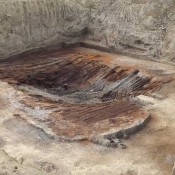
The excavation was carried out at Kurgan No. 4 in the Sarıyokuş area of the Keşikçidağ site, in Azerbaijan’s Ağstafa district. The research is being conducted in cooperation with the Institute of Archaeology and Anthropology of the Azerbaijan National Academy of Sciences (ANAS), under the direction of archaeologist Vagif Asadov.
Based on the archaeological evidence, the team dates the burial mound to the Middle Bronze Age, around the 17th–16th centuries BC.
The stone-covered kurgan measures approximately 12 metres in diameter. It rises about 80 centimetres above the surrounding surface, while the burial structure extends to a depth of approximately 1–1.2 metres.
Among the objects recovered from the burial chamber is a bronze dagger, which archaeologists regard as one of the indications that the deceased may have been a warrior or military leader.
One of the most distinctive discoveries is a carefully worked diorite sceptre head, weighing approximately 400–500 grams. The object has a central perforation extending through it, which may once have accommodated a handle made of wood or bone.
Archaeologists note that comparable sceptre heads may have served not simply as functional objects but also as symbols of authority and status in Bronze Age societies. Such objects could have been associated with members of the military elite, tribal leaders or commanders. The regular, symmetrical form of the Keşikçidağ example also provides evidence of the stone-working skills of craftspeople at the time.
A number of arrowheads were also recovered from the kurgan, including two made of black obsidian and nine of flint. The obsidian finds may provide evidence for access to regional sources of the volcanic glass and potentially for networks through which raw materials circulated, while the flint arrowheads are notable for their workmanship and form.
The finds, particularly the ceramic material recovered during the excavation, are currently undergoing preliminary conservation and laboratory examination before being added to the archaeological collection.
Radiocarbon dating is also planned to establish a more precise chronology for the burial and associated finds. According to the report, samples are expected to undergo analysis at laboratories in Tokyo and at the University of Miami.
The discoveries from Kurgan No. 4 add to the archaeological evidence for socially differentiated communities in the South Caucasus during the Middle Bronze Age and may provide further insight into the status, material culture and funerary practices of the region’s elites around 3,600 years ago.
 NOTES