Archaeologists in northwest China have identified a monumental late Warring States-period Qin mausoleum that may have belonged to Empress Dowager Huayang, an influential member of the Qin royal family and the adoptive grandmother of Qin Shi Huang, China’s first emperor.
The archaeological results from the Shangzhaoyao Qin Mausoleum, located in Weicheng District in Xianyang, Shaanxi Province, were announced by the Shaanxi Provincial Institute of Archaeology on September 18. Researchers have identified the complex as a royal-level Qin burial dating to the late Warring States period.
The site was first investigated in 2018, when archaeologists carried out exploratory work ahead of the third-phase expansion of Xi’an Xianyang International Airport. The investigation revealed a large ya-shaped tomb with its own independent funerary enclosure. Further excavation and survey work in 2022 allowed researchers to establish the overall layout of the cemetery. The site was subsequently named the Shangzhaoyao Qin Mausoleum after the former village of Shangzhaoyao in which it is located.
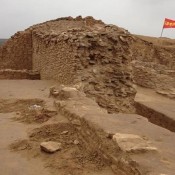
The nearly square funerary complex consists of outer and inner boundary ditches, an inner enclosure wall, the main tomb, accompanying and subsidiary burials, sacrificial pits and other features. The monumental main tomb stands at the centre of the inner enclosure, on the cemetery’s north-south axis, beneath a truncated-pyramid-shaped burial mound. Four sloping passages lead towards the approximately square burial chamber.
According to archaeologist Zhao Hanqing of the Shaanxi Provincial Institute of Archaeology, researchers identified 45 accompanying graves, 15 subsidiary burials and 62 sacrificial pits. Eight additional pits were found around the principal tomb. Five of the subsidiary burials were accompanied by chariot-and-horse pits, while seven had their own boundary ditches.
The scale of the main tomb reflects the exceptionally high status of its occupant. Including its four passages, the structure measures approximately 200 metres from east to west and 188.5 metres from north to south. The burial chamber itself measures around 56.6–59.7 metres on each side and reaches a depth of 26.4 metres. The surviving burial mound rises approximately 10 metres above the tomb.
Excavations yielded 258 artefacts or groups of artefacts, made from materials including pottery, bronze, iron, lead, jade, stone, agate, glass and bone. The pottery assemblage includes ritual and everyday vessel forms, some bearing stamped inscriptions. Bronze objects were found mainly in the subsidiary burials and include ding vessels and other containers. One bronze ding bears an inscription referring to the “Song family”.
Radiocarbon dating of human remains from the accompanying graves produced dates between 389 and 208 BC. Combined with the architecture of the tomb, the organisation of the cemetery and the characteristics of its artefacts, the results led archaeologists to date the mausoleum to the late Warring States period and classify it as a burial of Qin royal rank.
Researchers believe Empress Dowager Huayang is currently the most likely candidate for the occupant, although the identification has not been conclusively established.
Three other Qin mausoleum complexes — Zhoulingzhen, Yangjiagou and Sijiazhuang — had previously been identified in the wider Xianyang area, making Shangzhaoyao the fourth known Qin mausoleum complex there. Archaeologists noted particularly strong similarities between Shangzhaoyao and the Sijiazhuang Qin Mausoleum in their layout and design, suggesting that the two may be approximately contemporary and that their occupants may have been closely connected.
On the basis of these comparisons, historical records and what is known about Qin royal burial practices, the researchers have proposed that the mausoleum could have been constructed for a queen dowager of the late Qin state. Zhao said that Huayang is considered the most likely candidate.
The discovery provides important new archaeological evidence for the study of Qin royal cemeteries in the Xianyang region and may help researchers determine the identities of the individuals buried in other monumental Qin tombs in the area.
 NOTES