Archaeologists working at the former Tagua Tagua lake in central Chile have uncovered a substantial portion of a gomphothere skeleton dating back approximately 12,500 years, offering new evidence of interactions between Pleistocene megafauna and some of the region’s earliest human inhabitants.
The excavation, carried out between August 31 and September 14 in Chile’s O’Higgins Region, was led by Rafael Labarca, professor at the School of Anthropology of the Pontifical Catholic University of Chile (UC).
Gomphotheres were large herbivorous mammals distantly related to modern elephants. They inhabited Chile during the Pleistocene before becoming extinct around 10,000 years ago. Some could reach heights of up to four metres and weigh several tonnes, and their remains are among the most widespread evidence of megafauna found in the country.
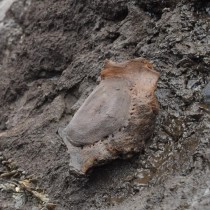
During the latest campaign at Tagua Tagua, researchers recovered a significant part of the skeleton of an adult gomphothere. The bones are exceptionally well preserved and include a humerus and fragments of the skull. According to the researchers, the skull appears to have been deliberately fractured, possibly to extract and consume the brain.
The remains were carefully lifted and protected with gauze and Japanese paper to ensure their safe removal and preservation.
The discovery was made opposite an area excavated in 1967 by archaeologist Julio Montané, suggesting that the archaeological site may extend over a considerably larger area than previously thought.
Research at the site began in 2023, when archaeologists opened a network of one-by-one-metre test pits to investigate evidence of human activity along the former lakeshore.
“We had the impression that the lake had been intensively occupied towards the end of the Pleistocene, approximately between 12,600 and 11,600 years before present,” Labarca explained.
Two of the test pits produced remains of extinct animals together with stone artefacts, prompting the team to expand the excavations in 2025 and 2026. The more extensive investigation has revealed abundant gomphothere remains, some horse bones, numerous remains of burned birds and lithic material.
“What we have found is, indeed, an association between abundant gomphothere remains, some horse remains, and many remains of burned birds, along with lithic material,” Labarca said.
According to the archaeologist, the finds indicate that people were exploiting a variety of animals living around the lake. Although radiocarbon dating has yet to confirm the chronology of the newly excavated material, researchers currently estimate that the occupation dates to between 12,600 and 12,400 years before present.
The project aims to reconstruct the ancient shoreline archaeologically and determine how different human groups used the lake and its resources over hundreds, or possibly thousands, of years.
“Tagua Tagua 3, Tagua Tagua 1, and the excavations we are currently carrying out, which we have called Tagua Tagua 1 East, show precisely that: how people settled sporadically on the edge of the lake at the end of the Pleistocene,” Labarca said.
Gomphotheres would themselves have played an important role in shaping the prehistoric landscape, feeding on grasses, bark and leaves. Their remains have been discovered at several locations in Chile, including Osorno, Puerto Montt and Tagua Tagua, in some cases together with evidence of human hunting and exploitation.
Tagua Tagua is considered an important location for investigating the relationship between megafauna and the first human populations of central Chile. The latest discovery adds to evidence that people repeatedly visited the shores of the ancient lake and made use of the rich animal resources available there during the final stages of the Pleistocene.
The excavations form part of the “Walking with Gomphothere” project, supported by the PALARQ Foundation, a Spanish non-profit organisation that funds archaeological and human palaeontological research. The 2026 campaign marks the fourth consecutive excavation conducted as part of the collaboration.
 NOTES