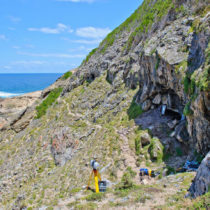
Scientists have identified traces of an antelope species in 60,000-year-old ochre-rich sediments from a South African archaeological site, revealing evidence of activities that left no visible remains. The discovery provides new insights into how early Homo sapiens may have combined mineral pigments with animal-derived materials for practical or symbolic purposes.
The research, published in Proceedings of the Royal Society B, was conducted by an international team involving Kyushu University, the University of Bergen and the University of Copenhagen. The scientists examined sediment samples from Klipdrift Shelter, part of the Klipdrift Complex in the De Hoop Nature Reserve on South Africa’s southern coast.
Their analysis revealed type I collagen associated with the common eland (Taurotragus oryx), a large African antelope. The proteins were recovered from an ochre-rich archaeological surface dating to approximately 60,000 years ago, during the Middle Stone Age.
Ochre, a naturally occurring mineral pigment commonly associated with red and yellow colouring, was widely used by prehistoric populations. Archaeological evidence suggests that it served various purposes, including pigment preparation, body decoration and other technical activities. However, identifying the organic substances that may have been combined with ochre has proved particularly difficult because such materials rarely survive over long periods.
To investigate the ancient deposits, the researchers employed palaeoproteomics, a technique that identifies proteins preserved in archaeological materials. Using liquid chromatography and tandem mass spectrometry, they extracted protein fragments from archived sediment samples and compared them with reference databases to determine their biological origins.
The identification of eland collagen is particularly significant because no animal tissue was visible in the excavated ochre-rich layer. The results suggest that animal products may have been deliberately mixed with powdered ochre or that hides treated with the pigment were processed at the site.
The ochre-rich surface itself was an unusual archaeological feature, extending for approximately one metre in length and 40 centimetres in width, with a thickness of up to one centimetre. Its composition and the presence of animal proteins raise questions about the activities that produced it.
The researchers also considered the possible symbolic significance of the discovery. Eland antelopes occupy an important place in the beliefs and rituals of historically documented San communities in southern Africa, where they have been associated with healing, marriage, power and rainmaking. Ochre, meanwhile, is frequently connected with symbolic expression in prehistoric contexts.
Although these associations offer an intriguing perspective, the scientists emphasise that the presence of eland proteins does not establish that the ancient deposit had a ritual function. Further evidence is required to distinguish symbolic practices from activities such as hide processing or the preparation of pigment mixtures.
Beyond its implications for early human behaviour, the study demonstrates the potential of ancient protein analysis in archaeological environments where DNA preservation is poor. Collagen can survive for tens of thousands of years, allowing researchers to identify biological materials that have otherwise disappeared from the archaeological record.
The findings open new possibilities for investigating prehistoric technologies and the emergence of symbolic practices. By applying similar methods to other archaeological deposits, researchers hope to determine whether the association between ochre and animal-derived substances was widespread during the Middle Stone Age and how these materials were used by early human communities.
 NOTES