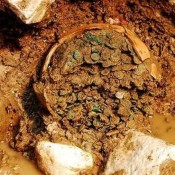
Archaeologists working at Kültepe-Kanesh in central Türkiye have uncovered the remains of a building with a mosaic floor dating to the Hellenistic period. The discovery is the first of its kind at the ancient settlement since systematic excavations began in 1948.
The find was made during the second season of a joint archaeological project involving Türkiye’s Ministry of Culture and Tourism, Ankara University and South Korea’s National Research Institute of Cultural Heritage. The excavations, directed by Professor Fikri Kulakoğlu, are taking place east of the Warşama Palace, where the international team began its investigations in 2025.
The surviving mosaic measures 163 centimetres from east to west and 165 centimetres from north to south. Additional fragments discovered nearby indicate that the original pavement extended beyond the preserved section.
Researchers have also established how the floor was constructed. After levelling the ground, the ancient builders prepared a foundation of crushed stone and fine soil, which they covered with small river pebbles. Ceramic fragments, lime and other materials were incorporated into the pavement.
Equally significant is the identification of four successive archaeological layers belonging to the Hellenistic period, conventionally dated between 323 and 30 BC. These deposits provide new evidence of architectural development and changing patterns of occupation at Kültepe during a phase of its history that has received comparatively little attention.
By examining the artefacts and architectural remains associated with each layer, archaeologists hope to establish a more detailed chronology of the settlement’s Hellenistic occupation.
Turkish Minister of Culture and Tourism Mehmet Nuri Ersoy described the discovery as an important milestone in the site’s 78-year excavation history. He also highlighted the contribution of the Turkish-South Korean archaeological collaboration.
Kültepe-Kanesh was one of ancient Anatolia’s major political and commercial centres. Occupied from the third millennium BC into the Roman period, it played a particularly important role during the Bronze Age, when it served as the capital of the Kingdom of Kanesh.
The settlement consisted of an upper city containing palaces and temples and a lower town that included a karum, or trading quarter, associated with Assyrian merchants. Excavations have uncovered approximately 23,500 cuneiform tablets documenting commercial transactions and aspects of everyday life. These archives are included in UNESCO’s Memory of the World Register.
Although Kültepe is best known for its Bronze Age remains, the newly discovered mosaic and Hellenistic layers demonstrate the importance of investigating its later occupation phases.
The archaeological site was added to UNESCO’s World Heritage Tentative List in 2014, and only a small proportion of its total area has been excavated.
Following the investigation of the Hellenistic deposits, the research team plans to continue into deeper archaeological layers associated with the Kingdom of Kanesh and the Hittite period, contributing to a fuller understanding of the settlement’s long history.
 NOTES