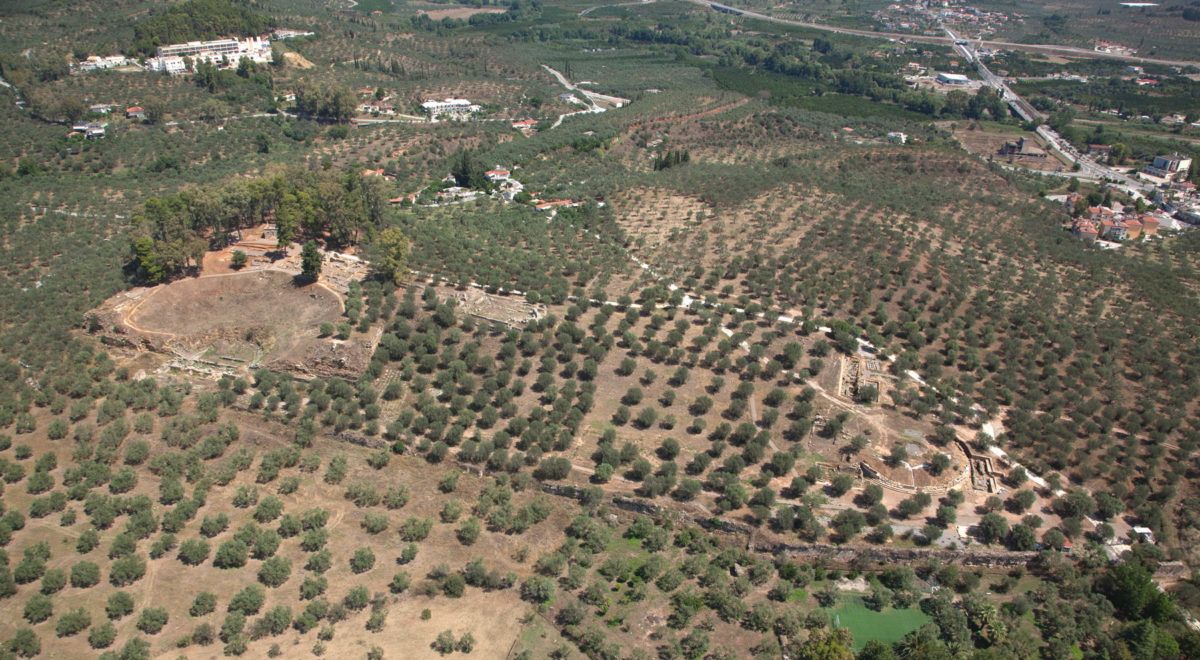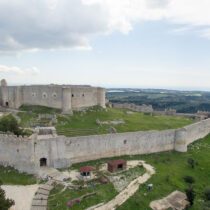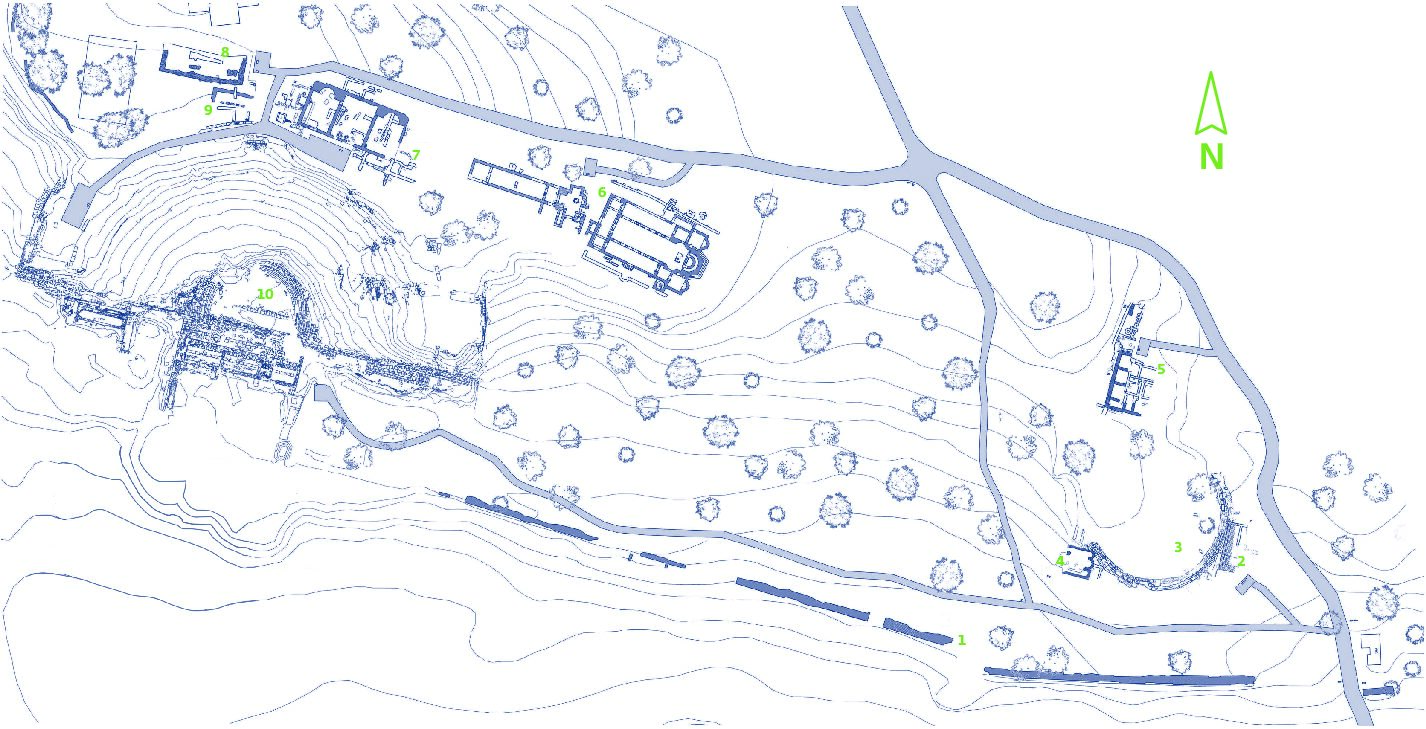
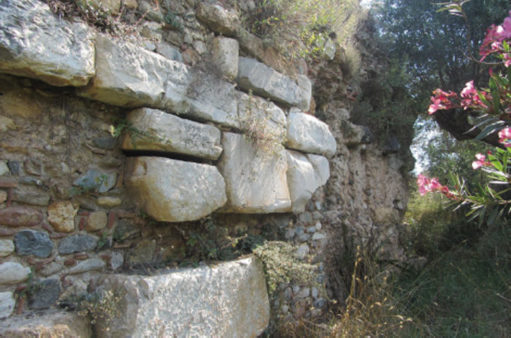
The Late Roman Wall that surrounds the acropolis hill and the Palaiokastron plateau is the first monument encountered by the visitor when approaching the archaeological site from the south. As we know, Sparta had no fortification walls in Classical times. The first fortification works and the wall surrounding four out of the five komai (villages) that formed Sparta date from the end of the 4th and from the 3rd century BC, when the once glorious city-state had started to decline and was no longer in the centre of developments. The Late Roman fortification is most probably associated with raids by the Eruli (267 AD) and Alaric (396 AD). The wall is a strong construction made of rubble and bricks, as well as a large number of stone blocks and architectural members from earlier buildings of the acropolis and the agora.
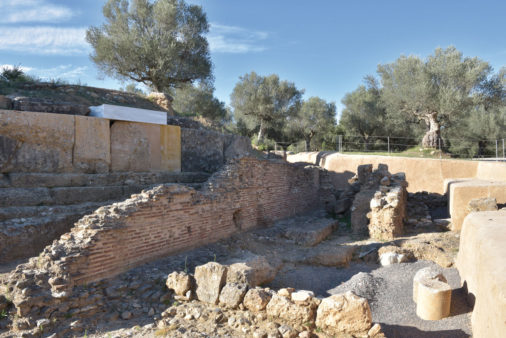
The Roman Stoa is situated at the southeast part of the Palaiokastron plateau. It is an impressive building from the first half of the 2nd century AD (125-150 AD), that functioned as the southern border of the agora in Roman times. With data resulting from the archaeological survey, the monument has been restored as a two storey stoa, possibly 187, 60 m long and 14.50 m wide and with a W-E orientation. The Roman Stoa had two storeys on most of its south facade and one storey on its north, due to the terrain’s north to south declivity. A Doric colonnade ran along both the north and the south side, while in the stoa’s interior there was a colonnade of Corinthian order. The western part of the stoa almost abuts the east part of the Round Building and its east part, which had a series of arched rooms, is located to the north of the Late Roman Wall. The different levels of the excavated parts of the building are due to the region’s uneven terrain.
Within the expropriated area of the archaeological site, the narrow west side of the stoa has been revealed, made of rows of brick and layers of mortar and which sits on a solid platform made of small stones and mortar. This wall probably belongs to the building’s first floor.
As documented in the excavation, the stoa underwent many alterations during the Byzantine period, from the 12th up to the mid 14th century. It is a particularly significant monument regarding the topography of Roman Sparta and most probably associated with the large scale operations and configuration work that took place in the agora area, during the rule of Gaius Julius Eurycles Herclanus (mid 2nd century AD).
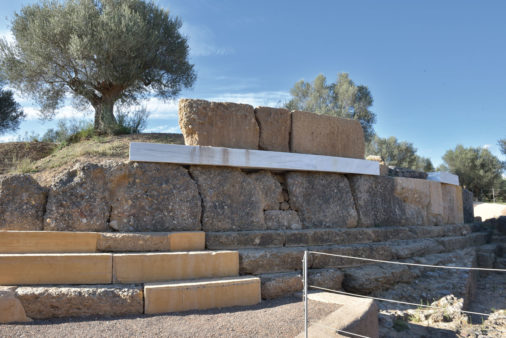
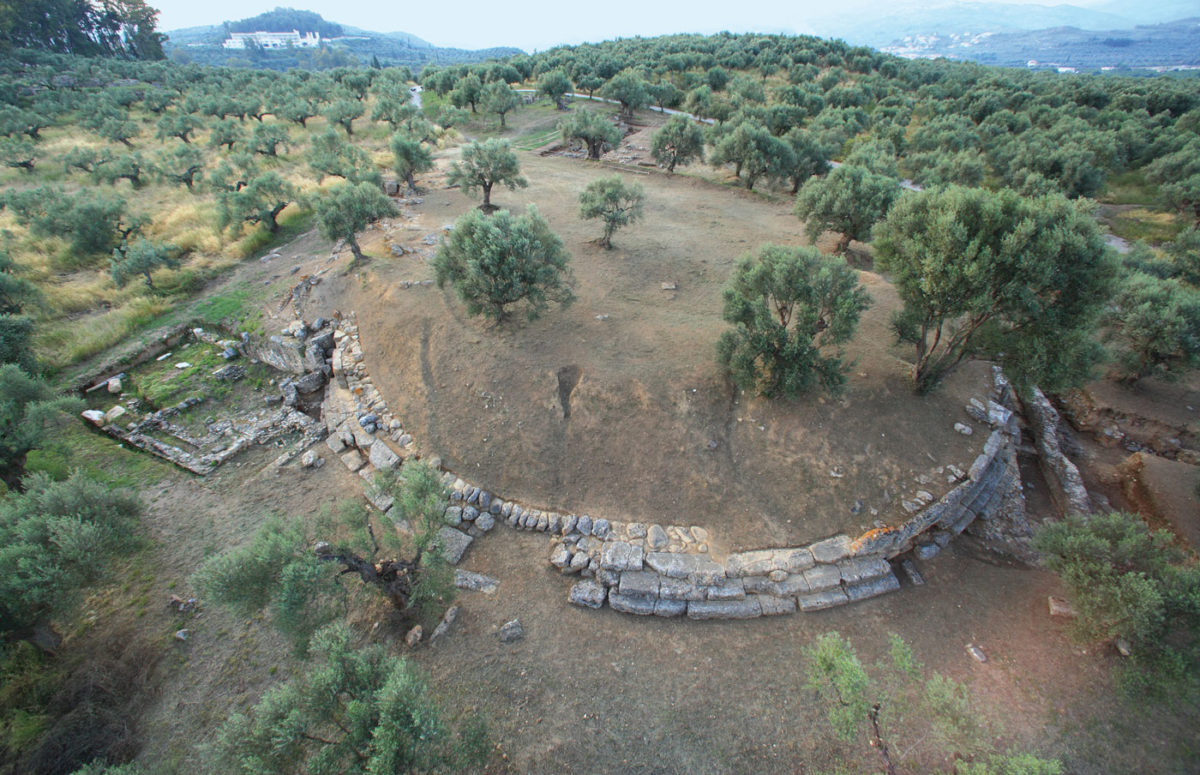
The so called Round Building dominates the southeast and lower part of the archaeological site of the acropolis and is located in the city’s agora.
It is essentially a natural low hill which has been transformed into a circular plateau, by the construction around it of a strong semicircular wall, from which the monument’s name originated. The wall consists of a three stepped base, on which rest tiers of large conglomerate stones, alternating with thinner layers of marble plinths. The inner part of the imposing curved wall consists mainly of large rough stones. At its west end, it forms a natural angle with a second wall of similar construction, over which a church was erected in the 10th century AD. In the 2nd century AD, a monumental stoa was constructed, almost touching the east part of the Round Building. Between these two monuments a strong construction has been unearthed, that consists of small pieces of rubble and rich mortar and is partly under the foundation of the Round Building. This work, which aimed to support the monument and ensure its stability, dates from Roman times, before the Roman Stoa was erected.
The constructions that existed on the hill’s surface are partly preserved and are backfilled today for their protection. Circular carvings have been revealed on the natural rock, part of a marble statue base of the Roman period and to the north, 22 rectangular blocks of porous stone arranged in almost concentric semicircles. These remains have been attributed to various structures, such as a circular paved surface with a colonnade, a wooden conical roof, even to some kind of theatre. During Roman times, the monument must have acquired a more imposing appearance and to have been reinforced structurally and statically, as made evident by the operations carried out on its east section and by the construction of the Roman Stoa. Excavation and architectural data show distinct housing and burial activities also during the Middle Byzantine period, i.e. the 10th century. Activity on this site, during this specific time, could also be associated with the adjacent Byzantine church.
The fact is that the Round Building was a timeless landmark and reference point for the city of Sparta. Its prominent position at the entrance of the administrative and religious centre of the ancient city, the fact that it is an unadorned yet monumental construction, easily adapted to the standards and aesthetics of each era and its powerful structure of massive immovable stones are some of the reasons that explain its continuous function from its founding in the Archaic period up to Byzantine times, changing its uses and serving different needs, depending on the period.
Consequently, it becomes a challenge to identify the monument with some site known from the sources, as well as determining its original character, since both it and its surrounding area were subjected to so much change, through successive modifications and additions. Among the many different proposals regarding its identity, the most popular are those that associate it with the Circular Building of Epimenides containing the statues of Olympian Zeus and Olympian Aphrodite (ca. 600 BC) and with the Skias, the place for public and musical gatherings, built by Theodoros of Samos (mid 6th c. BC).
According to Pausanias, these monuments were adjacent to one another. Taking into consideration that the one is referred to as “Periferes”, i.e. round and that the name “Skias” suggests a circular building with a protective cover like an “umbrella”, it is tempting to identify the Round Building with one of these two edifices. In that case, the wall with which the west part of the monument forms an angle could belong to its circular counterpart.
The church was built during the Middle Byzantine era (10th c. AD) on the site of an earlier also circular structure that formed an angle with the west end of the Round Building’s retaining wall.
It is an almost square building, with three curved segmental arches to the east and an entrance in the middle of the west wall. The church has been constructed of rubble and mortar, with fragments of bricks in the joints, while having incorporated many marble architectural members from ancient buildings pre existing on the site. Preserved on the inner face of its north wall are faded traces of painted decoration.
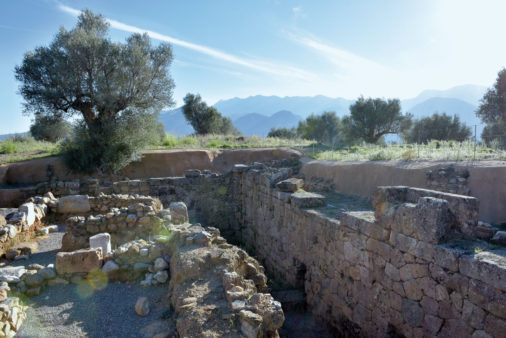
To the north of the Round Building a monumental stoa has been brought to light, known in bibliography as the “Agora”. The monument was excavated in the mid 1960s by Chrysanthos Chrystou. It is a large stoa which has been excavated only in its southwest inner corner. Its walls are constructed of large blocks of porous stone in the polygonal style, apart from their upper part and the transverse walls forming small rooms inside the stoa, that were built of limestone in the pseudo-isodomic way. The monument is positioned on the site where the city’s agora is located. Due to the downhill slope of the adjacent west hill, the stoa probably had two floors on the southeast side and one floor on the northwest which also served as a retaining wall. To the east and north of the building, house foundations and constructions from the Byzantine Period have been revealed. The stoa itself was subjected to additions and repairs during the Byzantine period.
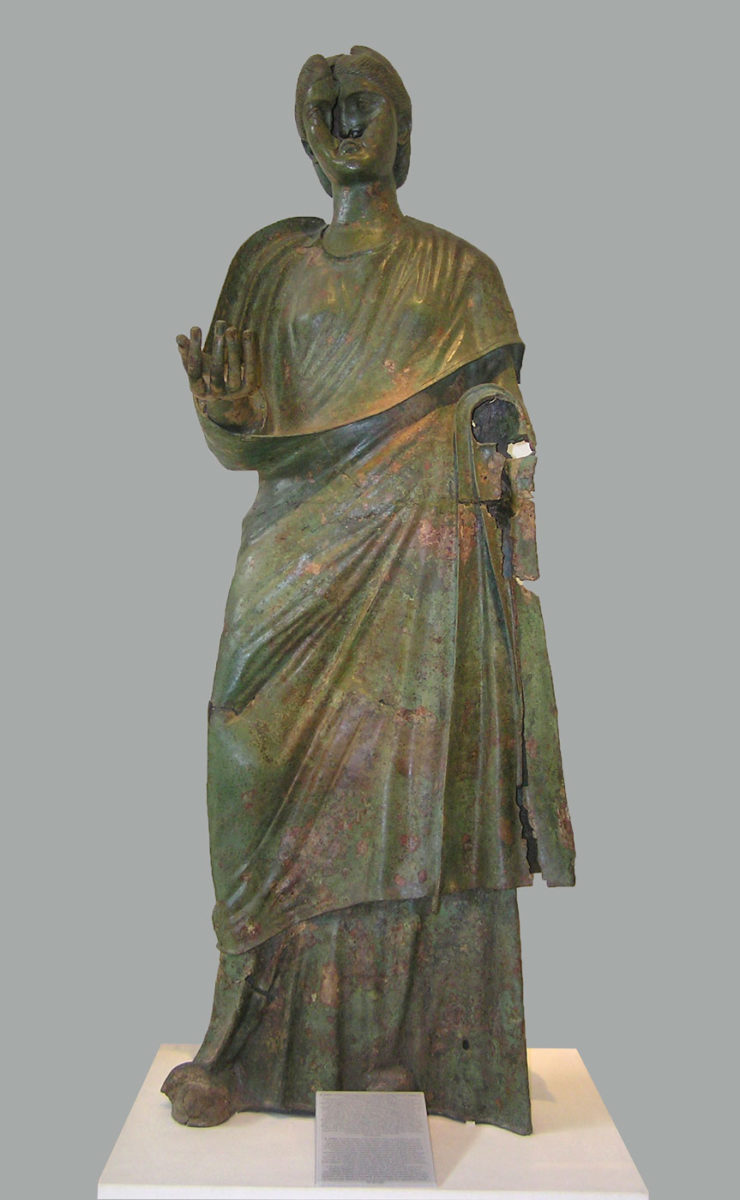
According to the excavator, the stoa was built in the 4th or 3rd century BC and underwent alterations in the 2nd century AD. There is ample evidence confirming the operation of the building till the 3rd century AD. Found in the stoa’s interior corner, under a layer of ruins bearing strong traces of a fire, was the portrait statue of the empress Julia Aquilia Severa (220-222 AD), wife of emperor Heliogabalus. The statue is housed today in the National Archaeological Museum (cat. no X 23321).The empress, wearing a chiton and himation, faces the front and holds out her surviving right hand. What impresses the visitor even today is the extensive damage done to the bronze statue which gives it a strange, almost macabre appearance. The excavator attributed its condition to damnation memoriae, i.e. the condemnation of the empress to eternal oblivion by damaging her image. With this argument as a starting point, the figure has been identified as one of the women of the Severan dynasty condemned to this specific sentence; namely Julia Mamaia, mother to the emperor Alexander Severus, Annia Faustina also wife to Heliogabalus and Plautilla, wife to Caracalla. According, however, to the most recent findings of the excavation, the disfigurements are probably due to building materials that crushed the statue in situ, when the building collapsed following a fire. This fact, combined with details in the figure’s rendering, such as the hairstyle and the face’s individual features, associate the statue with Julia Aquilia who had not been condemned to damnatio memoriae.
The partial excavation of the building does not provide the excavators with enough evidence identifying it as a specific monument. A popular theory is that it is the Persian Stoa, a building that impressed Pausanias when he visited the agora of Sparta in the 2nd century BC. In the Persian Stoa, constructed from spoils of the Persian Wars, the roof was supported not by columns but by statues of Persian prisoners on pedestals. According to another theory, the monumental stoa was part of a larger complex of two storey stoae situated in the south west part of the Agora area.
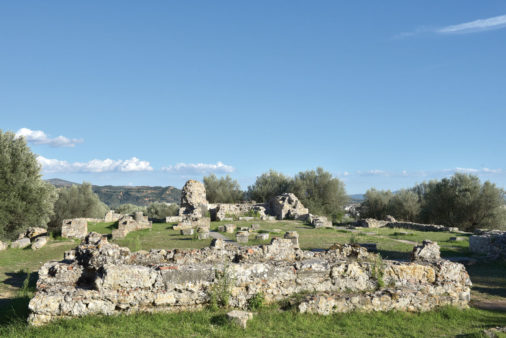
Ascending the paved path that leads from the agora to the acropolis, the visitor encounters an impressive building complex from the early Byzantine times. In its centre is a three-aisled basilica, with three sided arches to its east and a narthex to its west. The aisles are separated by columns placed on high pedestals.
The basilica has a sanctuary with three sections, which has slightly protruding sides. A semicircular area with seats (synthronon) is formed in the central apse, for the bishop and priests to be seated during the ceremonies and between the synthronon and the wall of the apse is a passage to facilitate the priests’ movements in the sanctuary, during the holy service.
Conclusions as to the monument’s reconstruction are still uncertain, while its dating is somewhere between the 2nd half of the 6th up to the 7th century. Its north section is probably a later addition, as are the stairways annexed to the south and west side. The cruciform structure to the west and the oblong building are added in the Middle Byzantine era.
Initially the monument had been identified as the church of Christ the Saviour which, according to the texts of the Life and Testament of St Nikon the so called “Metanoeite” (Repent), was built by the saint himself in the late 10th century. Today, it is considered to have been the cathedral of Lacedaemonia.
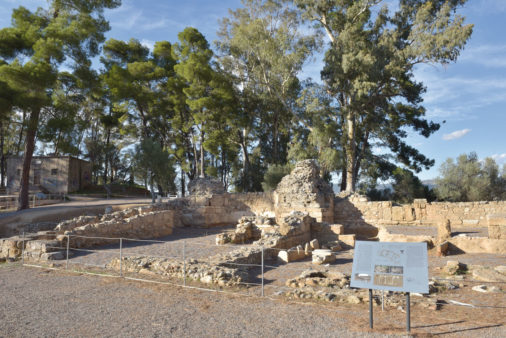
The Two-niched Building came to light in the east section of the acropolis hill of ancient Sparta, in an area lying between the shrine of Athena Chalkioikos and the basilica of “Osios Nikon”. It is a monumental building measuring 31×14.50 m. The original construction comprises a large central rectangular space, flanked to the east and west by two smaller rooms, each with a semicircular niche in its north wall. The building has been constructed with rubble, stone plinths, bricks, tiles and a great number of marble architectural members from older buildings of the acropolis, inscriptions being also among them. Overtime, the construction underwent many repairs, modifications and additions, as it was in use at least since Early Byzantine to Middle Byzantine times. The fact that it is built over the northern part of the theatre’s koilon (auditorium) places its construction after the 4th century AD, i.e. after the last period of the theatre’s operation. It is possible that, at some point, the function of the building was associated with the adjacent basilica of “Osios Nikon”.
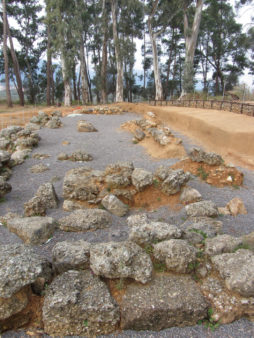
The remains of the sanctuary of Athena Chalkioikos survive at the top of the acropolis hill, above the theatre’s koilon (auditorium). It is the most important sanctuary and has the longest history among those in the district of the acropolis and the agora of ancient Sparta. It came to light in the early 20th century, when excavated by the British School at Athens The sanctuary’s age establishes its connection with the legendary king Tyndareus, father of Helen of Troy and the Dioscouri, and Lycurgus the legislator. There is evidence that Athena had been worshipped in the acropolis area since the 8th century BC, when her sanctuary and the acropolis hill belonged to Pitane, one of the four neighbouring villages that made up ancient Sparta. Later, Athena of the acropolis was raised to the status of patron goddess of the city. Ancient writers refer to the goddess as “Poliouchos” and “Chalkioikos”. According to the most prevailing theory, the name Chalkioikos (Bronze House) originates from the sheets of bronze that adorned the inner walls of the temple and bore mythological scenes, described by Pausanias. Both the temple’s bronze decoration and the goddess’s bronze statue were works of the Spartan artist Gitiadas, who renovated the sanctuary most probably around the end of the 6th century BC.
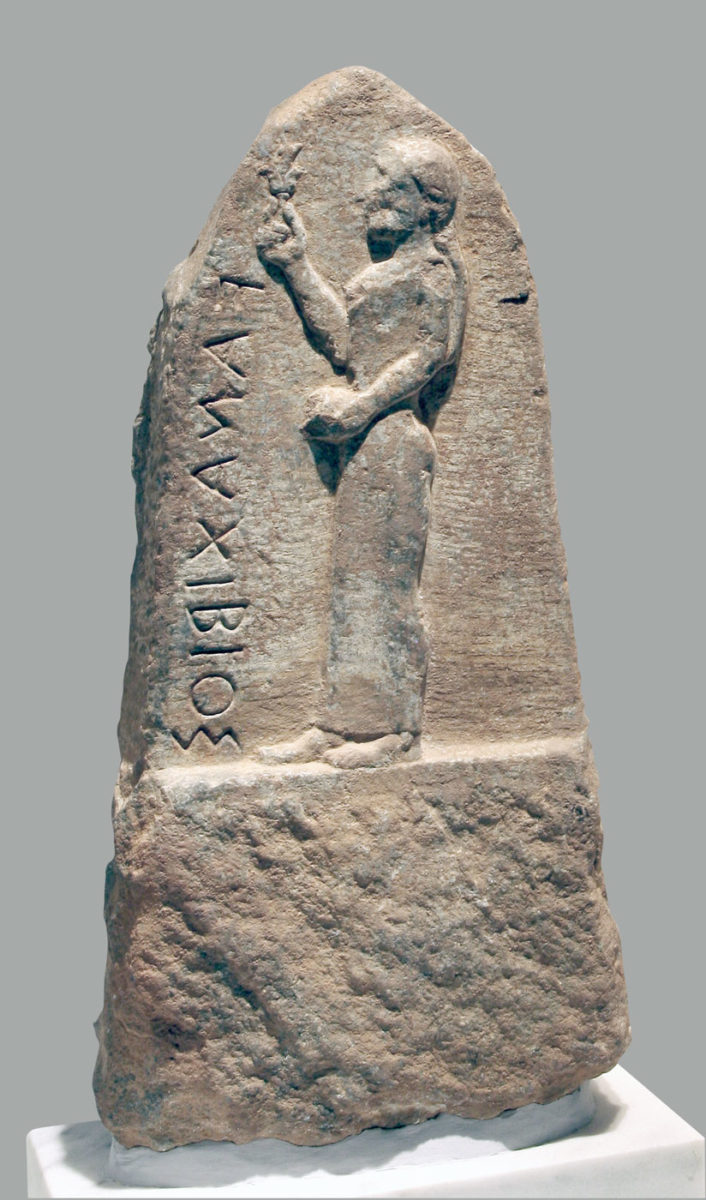
A characteristic votive offering dating from the 6th century BC was found in Athena’s shrine and is displayed in the Archaeological Museum of Sparta (inv. no S.M. 1030). It is a votive stele in relief, known as the ‟Anaxibios stele”, depicting a standing female figure, the Laconian version of the archaic Kore. She is standing in profile, facing the left and holds a fruit in her left hand and a lotus flower in her right, as offerings to the goddess. The name of the dedicator FΑΝΑΧΙΒΙΟΣ (Anaxibios) is written along the left side of the stele. The robust proportions and the unadorned yet clear rendering of the figure, the boldly treated stele, even its relatively small size (height 58.2 cm, width 29cm, length 14 cm),make it a typical work of a Laconian workshop, reflecting the trend in Late Archaic times of restraining any luxury in Sparta’s style of living.
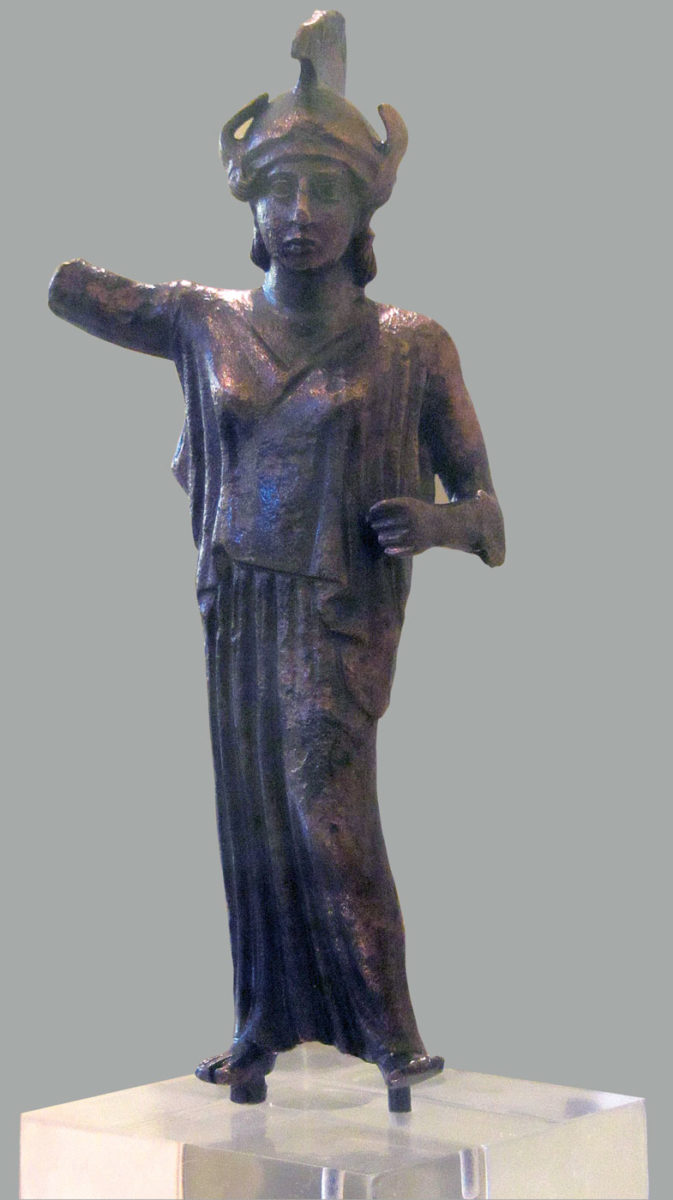
The sanctuary’s peak is in the 5th century BC, as can also be seen from the type and increased number of its votive offerings, mainly the bronze artefacts. Such representative examples are the various types of bronze figurines depicting the goddess herself. In one of these, dating from before the mid 5th century BC, Athena is shown wearing the Doric peplos and in full military garb (inv. no S.M. 240). The figure is standing, with her weight on her right leg and the left one slightly bent. In her missing right hand she was holding a spear and in the left a shield of which only the handle remains. A characteristic feature of the figurine is the Doric inscription ΑΘΑΝΑΙΑ[Ι] written across the helmet’s tall crest, identifying the goddess to whom the votive offering is intended.
A large group of votive offerings from the shrine of Athena Chalkioikos consist of dozens of bronze and terracotta votive bells, most of which date from the 5th century BC. Some bronze bells were inscribed and bore the name of the goddess and the dedicator. Such types of offerings have also been found in other sanctuaries of Sparta and Greece, their dedication however to the patron goddess of Sparta is probably associated with the magic and apotropaic character attributed to them. Their distinct sound sent out the signal for the city’s protection, but also shielded the dedicator, whether man or woman, from evil.
The cult at the temple of Athena Chalkioikos was, moreover, closely linked with the city’s public and military life. It was the gathering place of adult soldiers and final destination of the procession of young armed Spartans, while it was also chosen for the display of feats not only in battle but in various games. There are certain characteristic offerings related to the above, found on the site and kept in the Archaeological Museum of Sparta, such as part of a votive shield, an inscribed miniature breast plate, a vase shaped like a miniature helmet, the figurine of a hoplite, inscribed late archaic marble halters (hand held weights) etc.
The famous Damonon stele (inv. no, S.M. 440) that dates from the 2nd half of the 5th century BC, is a unique testimony to the horse races that took place in Sparta and paints the portrait of a wealthy Spartan and horse owner. Being very proud of his achievements, Damonon somehow defied the restrictions prevailing in Sparta regarding the display of wealth and success. He dedicated a stele to the goddess Athena that lists a great number of equestrian and athletic games won by him and his son Enymakratidas on Spartan territory. The Doric inscription is crowned with the relief of a tethrippon (chariot drawn by four horses), as the stele is primarily related to the dedicator’s successes in horse races, recording 43 victories in a four horse chariot and 21 victories in horse races.
A unique, emblematic sculpture from a Laconian workshop was found in the sanctuary area; the marble torso of a hoplite, on display today in the Museum of Sparta (inv. no S.M. 3365), known as “Leonidas” (480-470 BC). Only the torso and head of this remarkable piece of sculpture are preserved. The hoplite’s nude body has been vividly rendered with plasticity; it is leaning forward and twists slightly to the left, pulsating with an inner life and energy. The man wears a helmet with a high crest and cheek guards shaped like rams’ heads, while the inlaid eyes of some other material have not survived. The “frozen” smile in the archaic style emphasizes the threatening, decisive image conveyed by the figure. The man is depicted with a neatly trimmed beard but a shaven moustache in accordance with the requirements of the Ephors: “cut off your moustache and pay attention to the laws”(Plutarch, Kleomenes, 9).The sculpture made of Parian marble, is of the Severe Style and most probably the work of a Laconian artist. It has been identified as Leonidas, king of Sparta, who fell at Thermopylae, while according to some scholars it may have been part of a military sculptural group set up in the sanctuary of Athena.
The sanctuary of Athena Chalkioikos has been associated with dramatic moments of Spartan history, since Pausanias, victor of the Battle of Plataies (479 BC) sought refuge there, when accused of treason and hunted down by the Ephors for siding with the Persians. According to the historian Thucydides, the Ephors trapped Pausanias inside the building, having taken off its roof, and left him there to die, dragging him out of the sacred precinct as he was breathing his last, to avoid contaminating the space (Thuc. I.134).
Situated between the south wall of the Athena Chalkioikos sanctuary and the ancient theatre are the ruins of a stoa discovered and excavated by the British School at Athens between 1924 and 1925. The stoa, of which 11 m survive, has an E-W orientation and runs parallel to the south wall of Athena’s sanctuary. A section of the north and south wall is preserved with masonry of large rough stones.
Five limestone column bases define the monument on its south part. On the bases’ upper surface a shallow hollow is formed, possibly to receive a small base which would support a wooden column. To the south of the stoa are the remains of a Roman building, a section of which vertically intersects its north wall.
According to Pausanias, at the end of the 6th century BC, important work was carried out on the site of the Athena Chalkioikos sanctuary, such as the creation of the bronze statue of the goddess by the Spartan sculptor Gitiadas. The stoa may be associated with these projects and it could perhaps be identified as the one, to the south of the sanctuary, mentioned by Pausanias. The architectural remains discovered by British excavators to the southwest of the stoa, are attributed to the sanctuary of Athena Ergane and are not visible today.
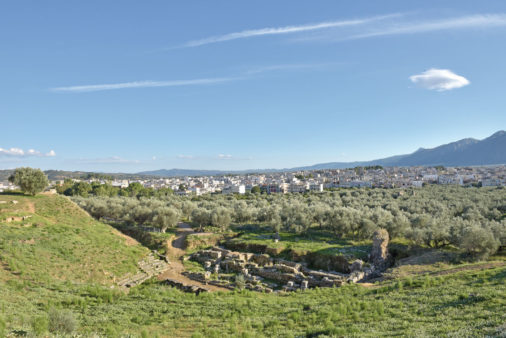
The Roman theatre of ancient Sparta is situated on the south slope of the acropolis hill and faces south towards the Eurota’s valley and the city. The main access to the site is made from the east and to get there one must walk south of the Round Building and continue west, parallel to the south section of the Late Roman Wall. The existence of a theatre in the city of Sparta is already testified by ancient writers in the 5th century BC and is directly related to the celebration of religious events such as the Gymnopaidiae. Nevertheless, it has not been confirmed by archaeological surveys whether the theatre of Classical times had been founded on the same spot as the one seen by today’s visitor. The theatre’s construction dates from the transition of the Hellenistic to the Early Roman period, i.e. possibly 30-20 BC, and has in fact been associated with the reign of Gaius Julius Eurycles, friend of emperor Octavian Augustus, victor of the naval battle of Actium. The theatre of Sparta stands out for its size and the quality and luxury of its construction, reflected in the use of local white marble. The main theatre had ten stairways (klimakes) and nine rows of bleachers (kerkides) and the upper part of the theatre (epitheatron) had seventeen stairways (klimakes) and sixteen rows of bleachers (kerkides), while in all probability, construction had been planned of a second diazoma and epitheatron. It has been estimated that this huge building could accommodate 17,000 spectators. In the lower section of the koilon there was a row of benches with backrests; the prohedria.
The theatre, whose koilon had a diameter of 141m, was one of the biggest in Greece and had a large stage building (skene), an acting area (proskenion) and a U-shaped orchestra. Two huge retaining walls had been built to form the two edges of the theatre, constituting a significant technical achievement. One more notable feature of the theatre was the existence of a mobile wooden skene, predating the marble koilon. The wooden skene moved on wheels along a triple stone corridor and was stored in a building called the skenotheke, by the entrance (parodos) on the theatre’s west side. The use of a mobile skene suggests the need for available free space, most probably because the theatre also functioned as a place for public gatherings and religious celebrations with dancing and games.
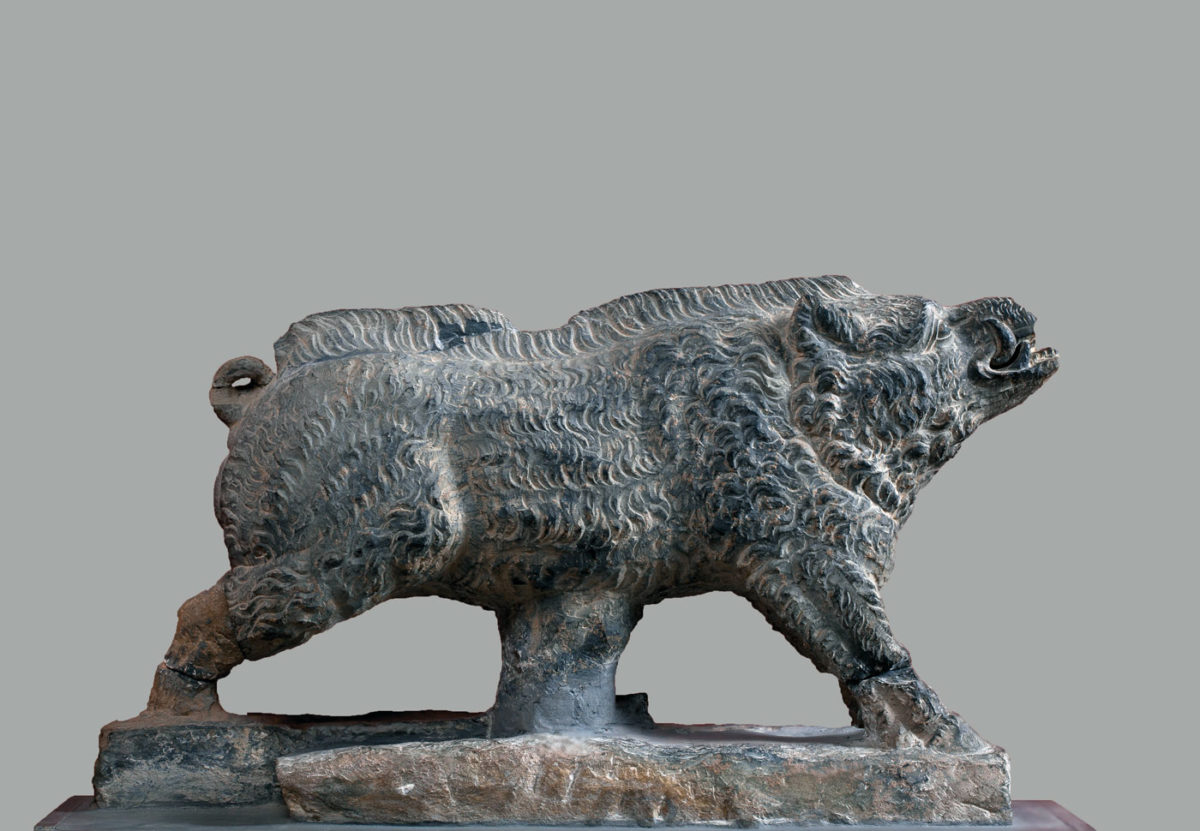
At the end of the 1st century AD, the theatre acquired a fixed, monumental marble skene in the Corinthian order whose construction was funded by the emperor Vespasian. After the stone skene was built, in place of the skenotheke, a long narrow reservoir (nymphaeon) was made, with U shaped ends on its two narrow sides. While excavating the theatre of Sparta, numerous fragments of statues, mainly from imperial times, were found in the nymphaeon area. One was the torso of a statue in the style of Apollo Lyceios, portrait heads of the late Roman period, the headless statue of a priestess, herm stelae with the head of Hercules etc. On display in the Museum of Sparta is the sculpture of a wild boar (inv. no S.M. 3367), also found in the nymphaeon district in 1927 and dating from the Late Hellenistic period. The wild boar, made of dark grey-blue marble, has been rendered in a lively realistic manner, running with its head raised and its legs outstretched. The almost decorative rendering of its fur and mane is impressive in its detail. The head with the tusks and half open mouth add to the animal’s frightening appearance.
The marble facade of the retaining wall of the east parodos constitutes a rare inscribed monument in Greece, recording catalogues with names of Spartan state officials and cursus honorum of the 2nd century AD.
The theatre was in use with some alterations and repairs till the end of the 3rd and the beginning of the 4th century AD, when the Late Roman Wall surrounding the Spartan acropolis was erected and incorporated the west wall of the stage building. Architectural members from the skene’s facade and retaining walls of the parodoi were used as building materials for its construction
After a period of abandonment, a Byzantine settlement was established, that was inhabited from the 10th to the 14th century. Architectural and functional elements of the theatre, such as marble benches and porous stone bases, were used as building material for the houses of the Byzantine settlement that took up all of the koilon.
In 1834, the founding of the new town led to a new phase in the destruction of the theatre, since the monument was plundered to use its stones as building material for the construction of modern Sparta.
For centuries, the acropolis of ancient Sparta had been the heart of a glorious and unique city, bearing witness to both its uninterrupted historical and cultural continuity and its course from fame towards oblivion. It is a unique aesthetic and educational experience to tour the acropolis of ancient Sparta which has been recently restored and has become, in the words of Pausanias, “worth seeing”. This is achieved by the remains of Sparta having been brought to life by the works and stories of ordinary people and brave men who lived in that place.
Introduction
When the modern town of Sparta was founded in 1834 by decree of king Otto, the renowned ancient town’s acropolis, with its already discovered antiquities, constituted its centre, south of which new Sparta was built, literally, upon the ancient remains. The attempt to revive the grandeur of an ancient Greek city, while rebuilding the modern Greek state also reflected the spirit of European Romanticism, not only in the actual founding of Sparta, but also in its Hippodameian town planning design, the Neoclassical style of its public buildings and even in the choice of its location. Nevertheless, with the passage of time, the harmonious coexistence of ancient and modern Sparta proved a challenge, since the conflict between the old and the new is inevitable in a small place when it is home to centuries of human activity.
The capstone of both the ancient and new town was the archaeological site of the acropolis and the agora of ancient Sparta; its administrative and religious centre. Here monuments have come to light that are representative of the ancient town’s historical course and the changes of its character over different periods. These remains are evidence of the area’s continuous and systematic use from early Geometric to Late Byzantine times.
Since the 15th century, the remains of ancient Sparta had attracted the attention of travelers and scholars. In the 18th and 19th centuries, however, this interest was expressed more systematically and led to ancient sites and monuments being identified, recorded, plotted and even excavated. In 1875, Panagiotis Stamatakis, sent by the Archaeological Society at Athens, endorsed the expropriation of the ancient theatre. The so called “Round Building”, situated in the south section of the agora, is the first monument to have been systematically excavated in 1892 and published by archaeologists C. Waldstein and C.L. Meader of the American School of Classical Studies at Athens. The British School at Athens worked systematically on the acropolis and the agora of Sparta right through the 20th century. During the 1930s, Adamantios Adamantiou and Georgios Soteriou worked on the acropolis and following its suspension brought about by the Second World War, research was resumed between 1960 and 1962, funded by the Archaeological Society and supervised by Chrysanthos Christou, who unearthed a monumental stoa in the area of the agora. G. Steinhauer also worked on the theatre in 1974 and excavated part of its koilon (auditorium). A five year survey programme on the theatre began in 2007, with the (former) 5th Ephorate of Prehistoric and Classical Antiquities and the 5th Ephorate of Byzantine Antiquities, collaborating with the British School at Athens. In 2012 and 2013, the “Study for the restoration of the ancient theatre of Sparta” was carried out and approved by the Central Archaeological Council. The project was funded by the Stavros Niarchos Foundation and assigned to an architect-restorer, member of the nonprofit Association “Diazoma”.
Systematic conservation and enhancement work was first done on the whole of the archaeological site between 2011 and 2015, as part of the project “Protection, Configuration, Enhancement and Connection of the Archaeological Sites of Sparta” which had been included in the Regional Operational Programme for “Western Greece-Peloponnese-Ionian Islands 2007-2013”. The project was initially implemented by the (former) 5th Ephorate of Classical Antiquities and then by the Ephorate of Antiquities of Lakonia. Upon the project’s completion, the town of Sparta acquired an organized archaeological site open to visitors, with service facilities for the public, sign posting and information boards, touring routes and resting spots with a view. The enhancement of the town’s main archaeological site and the creation of touring routes that connect the monuments, contribute in creating a picture of ancient Sparta that is as complete as possible. Moreover, the organizing of representative sub sets easily understood by the visitor, help him/her approach particular aspects of life in the ancient Greek, Roman and Byzantine town.
The acropolis
The acropolis of ancient Sparta is the highest of the gentle slopes to the north of the town. The Greek traveler Pausanias who visited the town in the mid 2nd century AD is a valuable source of information on Sparta’s topography, not just of Roman but also of Classical times. From him and other ancient sources we learn that on the acropolis was one of the most important old sanctuaries of Sparta; that of Athena Poliouchos or Chalkioikos. Pausanias encountered other places of worship near the sanctuary of Athena Chalkioikos; the temple of Athena Ergane, another in honour of the Muses, the temples of Zeus Cosmetas and Aphrodite Areia, as well as porticos, the tomb of the legendary king Tyndareus, statues and votive offerings.
The agora
Most scholars place the agora of ancient Sparta to the east of the acropolis, on a plateau of Palaiokastron hill. Thucydides notes the lack of luxurious buildings and temples in 5th century Sparta and the fact that the image of the city does not correspond to the power and glory of the Lacedaemonians during the Peloponnesian War. The historian writes characteristically: “For if the city of Lacedaemon were now desolate and nothing of it left but the temples and floors of the buildings, I think it would breed much unbelief in posterity long hence of their power in comparison of the fame […] the city being not close built and the temples and other edifices not costly […]” (Thucydides Ι.10.2). Pausanias, nevertheless, was impressed by the agora of the 2nd century AD, where all the administrative and religious functions of the city took place. He describes it as “worth seeing” (Pausanias ΙΙΙ.11.2) and mentions numerous shrines, monuments, tombs and public buildings he encountered in its broader area. Among others, he refers to the council chamber of the Gerousia, the buildings of the Ephors, the temples of Caesar and Augustus, the sanctuaries of Gaia, Zeus Agoraios and Athena Agoraia, Zeus Xenios and Athena Xenia, the tomb of Orestes, the colossal statue of the Demos of Sparta and the statue of Hermes Agoraios and Dionysus as a child. He also records other buildings, such as the Choros, where the Gymnopaediae feast was held in honour of Apollo, the Skias, a place for public and music events and the Round Building with the statues of Olympian Zeus and Olympian Aphrodite. Pausanias is particularly impressed by the luxurious theatre and the Persian Stoa, the most imposing of the agora buildings. Most of the monuments Pausanias encountered in the area of the agora date from the Archaic and Roman times, high points in Sparta’s history. On the site of today’s acropolis and agora, one sees remains of buildings which had a variety of uses and functions over the centuries. These include Archaic and Classical monuments, porticos, public buildings and private houses from Roman times, temples, public buildings and houses from the Byzantine era.