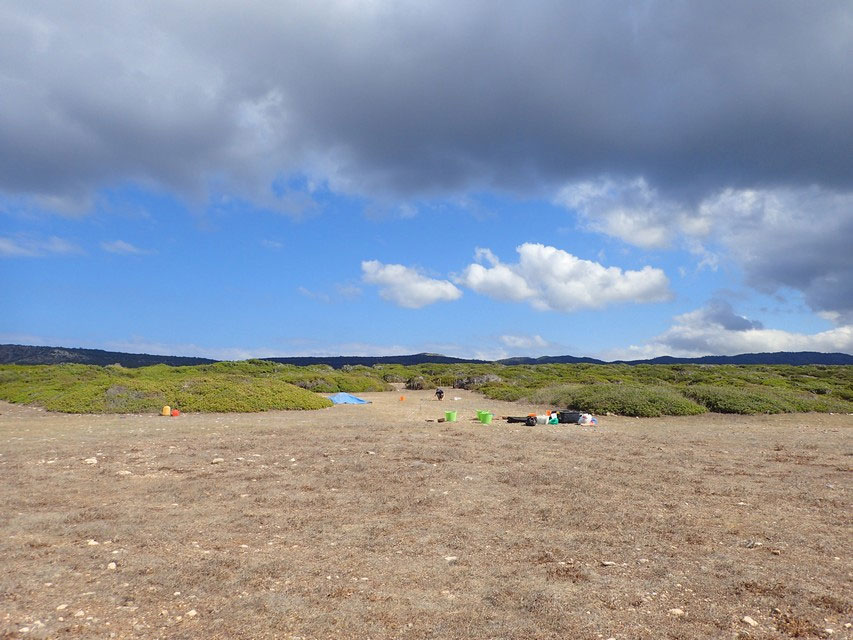
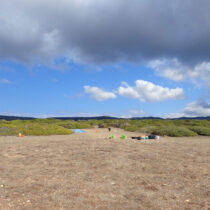
The Department of Antiquities of the Deputy Ministry of Culture announces the completion of the archaeological excavation carried out in October 2025 at the newly identified site of Drouseia Skloinikia (Figure 1) in the northwest sector of the Akamas Peninsula. The research was conducted under the direction of Dr Theodora Moutsiou, Special Scientist of the Archaeological Research Unit of the University of Cyprus, in collaboration with Dr Christian Reepmeyer, an Archaeologist from the German Archaeological Institute. Undergraduate and postgraduate students of the University of Cyprus, University of Athens, University of Cologne and Roma Tre University participated in this year’s mission.
The excavation is part of the Exploring the role of coasts in the early prehistory of Cyprus: Integrating archaeological excavations and geospatial technologies at the remote Akamas promontory (Project TOPOS) field research funded by the A.G. Leventis Foundation Overseas.
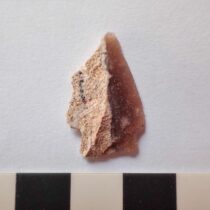
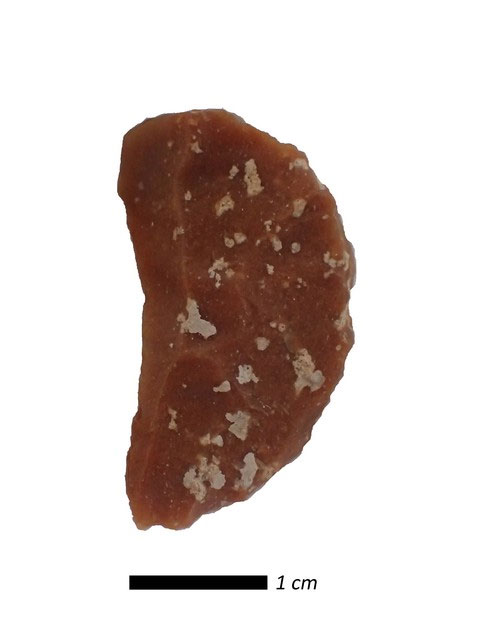
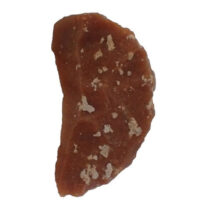
The 2025 campaign continues the work of the previous year whereby a geophysical survey undertaken by the Digital Humanities GeoInformatics Lab of the Department of History and Archaeology, University of Cyprus, under the supervision of Professor Apostolos Sarris, mapped a series of outstanding magnetic anomalies/subsurface characteristics that were investigated via systematic excavation. Five trenches excavated to a maximum depth of 60cm unearthed a rich artefact assemblage including chipped stone, beads, shells and bone artefacts. The 2025 field season’s main objective was to continue the excavation of the 2024 trenches to reach bedrock and to open up new trenches in order to examine the site’s stratigraphic sequence, site formation processes and systematically geo-refer and collect archaeological material for specialist analysis, all aimed at determining the extent, nature and chronological framework of the site. Hundreds of stone artefacts (Figure 2) have been recorded on site with typo-technological characteristics that provisionally position them at the Terminal Pleistocene – Early Holocene (12-8 ka), supported by initial AMS 14C radiocarbon dates that provide a terminus ante quem at around 8000 cal BP.
Overall, nine new trenches were drawn and excavated in 2025. One of the new trenches was dug to bedrock with the aim to gain a better understanding of site formation processes and for this purpose geomorphological samples were collected for further analysis. The remaining eight trenches were excavated only to about 20cm deep in order to clarify the nature of a peculiar magnetic anomaly detected during geophysical prospection in the field campaign of 2024. The excavation of this latter set of trenches unearthed an in-situ knapping floor, encompassing raw material blocks, cores, hammerstones as well as flakes, provides some initial insights into some of the tasks taking place at Skloinikia. Beads and bead preforms, groundstone and other stone implements, bone and shell artefacts complete this year’s excavated portable assemblage, while an extremely rich shell assemblage raises exciting questions as to the full range of resource exploitation activities performed by the site’s occupants.
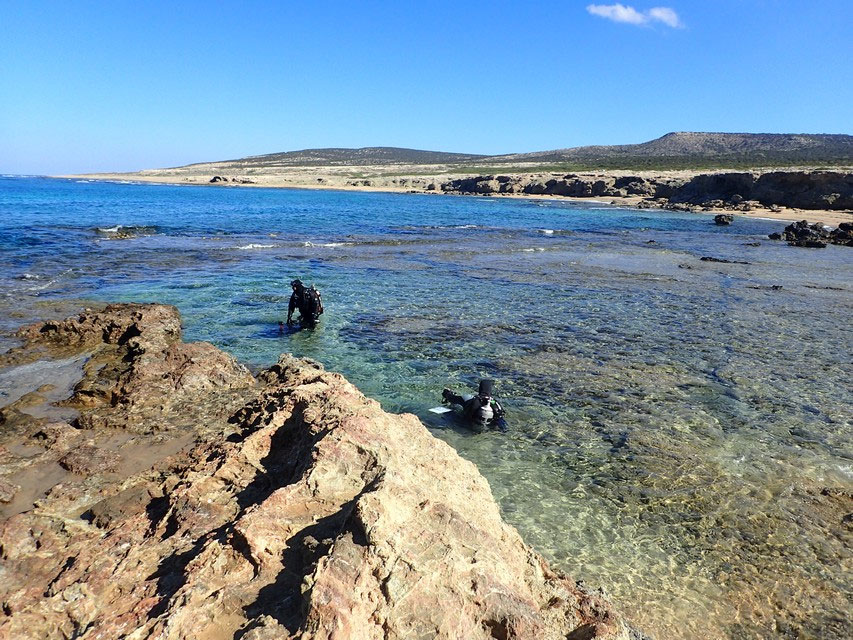
The work also encompassed a brief underwater survey (Figure 3) the aim of which was to assess the potential for the preservation of cultural material remains and/or geomorphological features indicative of submerged prehistoric landscapes. Given that at the time of Skloinikia’s occupation, at least 8000 years ago, the sea level was approximately 15m lower than today, the present reef area would have been exposed and accessible to humans for exploitation. Divers Filip Hájek (Department of Archaeology and Museology, Masaryk University and Institute of Archaeology, Czech Academy of Sciences) and Christos Patsalides’ (Amber Training & Support Services Ltd) preliminary field observations confirm a complex maritime cultural landscape warrantying further systematic underwater investigations in the near future. The long-lasting human relationship with the sea and the changing coastline of the Akamas Peninsula, in particular, will be further explored in the third mission of the University of Cyprus at Drouseia-Skloinikia expected to take place in September 2026.
Skloinikia adds important new data to the existing corpus of excavations that are bringing light to the early Neolithic past of Cyprus, evincing that the island can no longer be viewed as an isolated backwater to regional phenomena, but emerges instead as a dynamic component in the cultural processes of the period. The ongoing investigations of the University of Cyprus at Skloinikia and its surrounding area firmly position the Akamas Peninsula in the broader Eastern Mediterranean interaction sphere during the emergence of early Neolithic lifeways and help us define the development of prehistoric coastal communities, human migration trajectories and island settlement in deep time.
 NOTES
NOTES