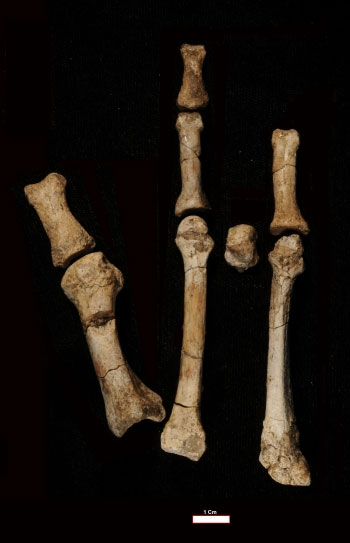
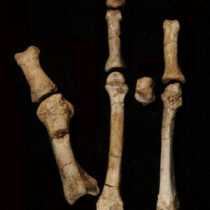
In 2009, scientists found eight bones from the foot of an ancient human ancestor within layers of million-year-old sediment in the Afar Rift in Ethiopia. The team, led by Arizona State University paleoanthropologist Yohannes Haile-Selassie, did not assign a species to the 3.4-million-year-old fossil — until now.
The fossil, called the Burtele Foot, was found at the Woranso-Mille paleontological site and was announced in a 2012 Nature article.
“When we found the foot in 2009 and announced it in 2012, we knew that it was different from Lucy’s species, Australopithecus afarensis, which is widely known from that time,” said Haile-Selassie, director of the Institute of Human Origins and professor at the School of Human Evolution and Social Change.
“However, it is not common practice in our field to name a species based on postcranial elements — meaning elements below the neck — so we were hoping that we would find something above the neck in clear association with the foot. Crania, jaws and teeth are usually the elements used in species recognition.”
When the Burtele Foot was announced, some teeth were already found from the same area, but the scientists were not convinced the teeth were from the same level of sediments. Then, in 2015, the team announced a new species, Australopithecus deyiremeda, from the same area — but were not able to conclusively include the foot into this species even though some of the specimens were found very close to the foot, Haile-Selassie says.
Now, after 10 years of going back into the field and continuing to find more fossils, Haile-Selassie said they have specimens that they can confidently associate with the Burtele Foot and with the species A. deyiremeda.
What’s in a name — and a foot?
The assignment of the Burtele Foot to a species is just part of the story.
The site of Woranso-Mille is significant because it is the only site where scientists have clear evidence showing two related hominin species co-existed at the same time in the same area, explained Haile-Selassie.
The Burtele Foot, belonging to A. deyiremeda, is more primitive than the feet of Lucy’s species, A. afarensis. The Burtele Foot retained an opposable big toe, which is important for climbing, and the toes were longer and more flexible — also suitable for climbing.
But when A. deyiremeda walked on two legs, it most likely pushed off on its second digit rather than its big toe like we modern humans do today.
“The presence of an abducted big toe in Ardipithecus ramidus was a big surprise because at 4.4 million years ago, there was still an early hominin ancestor which retained an opposable big toe, which was totally unexpected,” Haile-Selassie said.
“Then 1 million years later, at 3.4 million years ago, we find the Burtele Foot, which is even more surprising. This is a time when we see species like A. afarensis whose members were fully bipedal with an adducted big toe.
“So what that means is that bipedality — walking on two legs — in these early human ancestors came in various forms. The whole idea of finding specimens like the Burtele Foot tells you that there were many ways of walking on two legs when on the ground; there was not just one way until later.”
What teeth tell us
To get insight into the diet of A. deyiremeda, Naomi Levin, a professor at the University of Michigan, sampled eight of the 25 teeth found at the Burtele areas for isotope analysis. The process involves cleaning the teeth, making sure to only sample the enamel and using very tiny tools like today’s dentists use.
“I sample the tooth with a dental drill and a very tiny (< 1mm) bit. This equipment is the same kind that dentists use to work on your teeth,” Levin said. “With this drill, I carefully remove small amounts of powder. I store that powder in a plastic vial and transport it back to our lab at the University of Michigan for isotopic analysis.”
The results were surprising.
While Lucy’s species was a mixed feeder, eating C3 resources (from trees and shrubs) and C4 plants (tropical grasses and sedges), A. deyiremeda was utilizing mostly C3 resources.
“I was surprised that the carbon isotope signal was so clear and so similar to the carbon isotope data from the older hominins A. ramidus and Australopithecus anamensis,” she said. “I thought the distinctions between the diet of A. deyiremeda and A. afarensis would be harder to identify, but the isotope data show clearly that A. deyiremeda wasn’t accessing the same range of resources as A. afarensis, which is the earliest hominin shown to make use of C4 grass-based food resources.”
More clues from jaws
Along with the 25 teeth found at Burtele, scientists also found the jaw of a juvenile, which based on the anatomy of the teeth clearly belonged to A. deyiremeda.
This jaw had a full set of baby teeth already in position, but also had a lot of adult teeth developing deep down within the bony mandible, says Gary Schwartz, Institute of Human Origins research scientist and professor at the School of Human Evolution and Social Change.
The team used state-of-the-art micro-CT scanning technology to look at all of the developing teeth because there is a close connection between both the pattern and pace of tooth development with a species’ overall growth biology. This allowed the scientists to estimate that this jaw belonged to a hominin that was around 4.5 years old when it died.
“For a juvenile hominin of this age, we were able to see clear traces of a disconnect in growth between the front teeth (incisors) and the back chewing teeth (molars), much like is seen in living apes and in other early australopiths, like Lucy’s species,” Schwartz said.
“I think the biggest surprise was despite our growing awareness of how diverse these early australopith (early hominin) species were — in their size, in their diet, in their locomotor repertoires and in their anatomy — these early australopiths seem to be remarkably similar in the manner in which they grew up.”
Knowing how these ancient ancestors moved and what they ate provides scientists with new knowledge about how species coexisted at the same time without one pushing the other to extinction.
“All of our research to understand past ecosystems from millions of years ago is not just about curiosity or figuring out where we came from,” Haile-Selassie said. “It is our eagerness to learn about our present and the future as well.”
“If we don’t understand our past, we can’t fully understand the present or our future. What happened in the past, we see it happening today,” he said. “In a lot of ways, the climate change that we see today has happened so many times during the times of Lucy and A. deyiremeda. What we learn from that time could actually help us mitigate some of the worst outcomes of climate change today.”
The paper, “New finds shed light on diet and locomotion in Australopithecus deyiremeda,” was published in the journal Nature. Funding for this project was provided by the National Science Foundation and the W.M. Keck Foundation. Field and laboratory research in Ethiopia was facilitated by the Ethiopian Heritage Authority.
 NOTES
NOTES