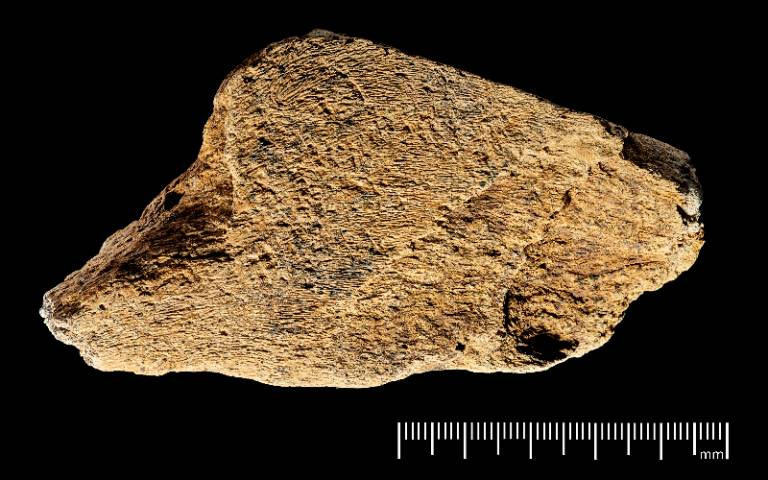
A remarkable prehistoric hammer made from elephant bone, dating back nearly half a million years ago, has been uncovered in southern England and analysed by archaeologists from UCL and the Natural History Museum, London.
It is the oldest elephant bone tool to ever be discovered in Europe and provides an extraordinary glimpse into the ingenuity of the early human ancestors who made it. The research, published in Science Advances, describes the roughly 500,000-year-old tool, and reveals the unexpectedly sophisticated craftsmanship and skill of the species responsible for making it, likely either early neanderthals or another species known as Homo heidelbergensis. The hand-held implement served as a soft hammer, used to sharpen ancient handaxes and other stone tools that became dulled through repeated use.
Lead author Simon Parfitt (UCL Institute of Archaeology and Scientific Associate at the Natural History Museum) said: “This remarkable discovery showcases the ingenuity and resourcefulness of our ancient ancestors. They possessed, not only a deep knowledge of the local materials around them, but also a sophisticated understanding of how to craft highly refined stone tools. Elephant bone would have been a rare but highly useful resource, and it’s likely this was a tool of considerable value.”
A tool made from elephant bone
The fossilised tool is roughly triangular in shape, measuring about 11 centimetres long, six centimetres in length and about three centimetres thick. It bears marks indicating that it was intentionally shaped for use as a tool.
It’s mostly composed of the dense, thick outer layer of bone tissue known as cortical bone. The tissue is thick and dense enough to indicate that it came from either an elephant or mammoth, but the fragment is too incomplete to determine the exact species or which part of the skeleton the bone fragment came from.
The fragment of elephant bone was discovered in the early 1990s but was not recognised as a tool until recently, when finds from the site were studied in detail.
Using 3D scanning methods and electron microscopes to analyse the surface of the bone fragment, the researchers found tell-tale notches and impact marks, indicating that the tool was used as a kind of hammer by its ancient owner. Tiny fragments of flint were embedded within the notches, showing that it was used to strike and shape stone tools, and likely used many times over.
Bone, being softer than stone, was often used for more precise tasks, such as sharpening the cutting edge of stone handaxes and other butchery tools. The researchers believe that this bone tool served as a “retoucher,” used to strike the edges of dulled stone tools to detach flakes to restore their shape and sharpness, a process known as “knapping.”
With its thick outer layer of hard tissue, elephant bone would have been more resilient as a hammer than other available animal bones, making it a preferred tool material.
Advanced use of a valuable resource
Mammoths and elephants were uncommon in the local landscape of prehistoric southern England, and the tool reveals the resourcefulness and cognitive capabilities of the early prehistoric human ancestors in the region. They were able to recognise that elephant bone was a preferable yet rare material that was worth seeking out and saving.
It also shows that the human ancestors of the region had a relatively advanced level of technological development, as the use of a retoucher facilitated the production of stone tools that were more refined and complex than some other contemporary prehistoric human populations.
Co-author Dr Silvia Bello, Merit Researcher at the Natural History Museum, said: “Our ancient ancestors were sophisticated in their use of tools. Collecting and shaping an elephant bone fragment and then using it on multiple occasions to shape and sharpen stone tools shows an advanced level of complex thinking and abstract thought. They were resourceful gatherers of available materials, and savvy about how best to use them.”
The tool was discovered at an archaeological site in Boxgrove, near Chichester in West Sussex, England. It’s an extensively excavated site, and numerous tools made of flint, bone, and antler have been discovered there; however, this is the first tool made from elephant bone.
It’s unclear whether the animal was hunted or whether the bone was scavenged from an already dead carcass, but some of the deformation of the bone tool indicates that it was shaped and used while the bone was relatively fresh.
Tools made from elephant bones have been discovered at Olduvai Gorge in Tanzania, dating as far back as 1.5 million years ago. Only a small number of elephant bone tools have been discovered in Europe older than 43,000 years – the point when modern humans (Homo sapiens) started spreading across Europe, and left behind large numbers of ivory and elephant bone tools, art objects and structures. No European elephant bone tools are older than from about 450,000 years ago, and most were found much farther south and in warmer climates.
The research was supported by English Heritage, UCL and the Calleva Foundation.
 NOTES
NOTES