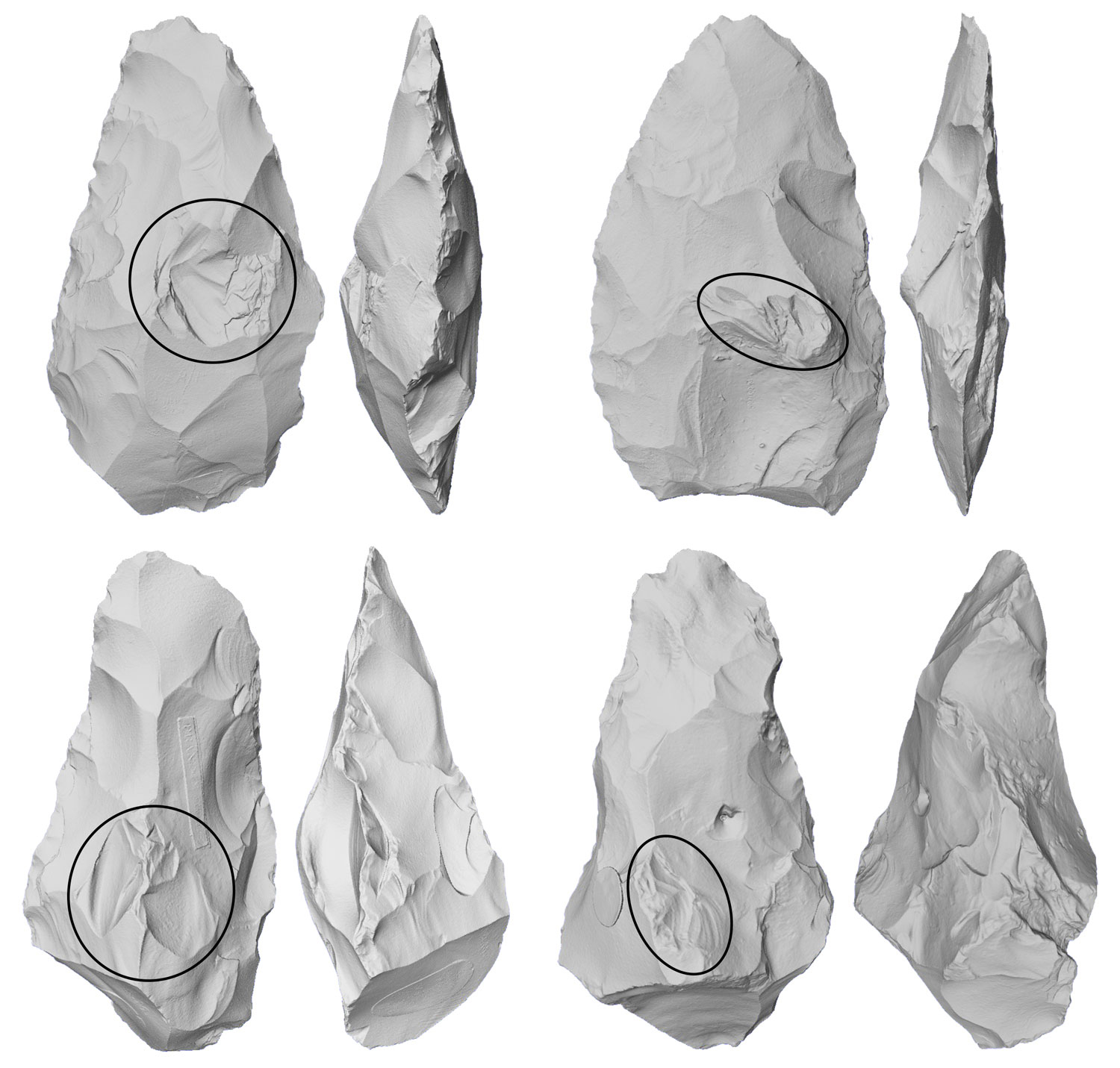
About 500,000 years ago, prehistoric humans living in what is now Britain (England) began to produce more refined stone axes than before — tools that show a significant improvement in skill and craftsmanship compared to earlier implements.
Archaeologists have found that around this time, the stone‑knapping techniques used to make hand axes became more advanced and standardized, suggesting that these early humans were not just focusing on survival but learning to shape tools with care and purpose.
What’s particularly interesting is that these changes in tool‑making skills may reflect deeper cognitive and social developments. Some researchers suggest that the transmission of improved techniques — and the need to teach and learn them — could indicate that these ancient groups were already using complex forms of communication, perhaps even early speech‑like systems — as advanced knapping training can produce changes in the right ventral premotor cortex of the brain, which is associated with fine motor control and speech.
Although it’s not known exactly which hominin species made these axes, the timing and location in Britain correspond to populations of archaic humans like Homo heidelbergensis.
In short: half a million years ago, stone tools in Britain suddenly show signs of greater care and skill, and this shift might hint that prehistoric people had not only improved their technology but also the social and communicative capacities needed to share and teach those innovations.
The research was conducted by Ceri Shipton and colleagues at the Australian National University, based on tool finds in southeastern England.
 NOTES
NOTES