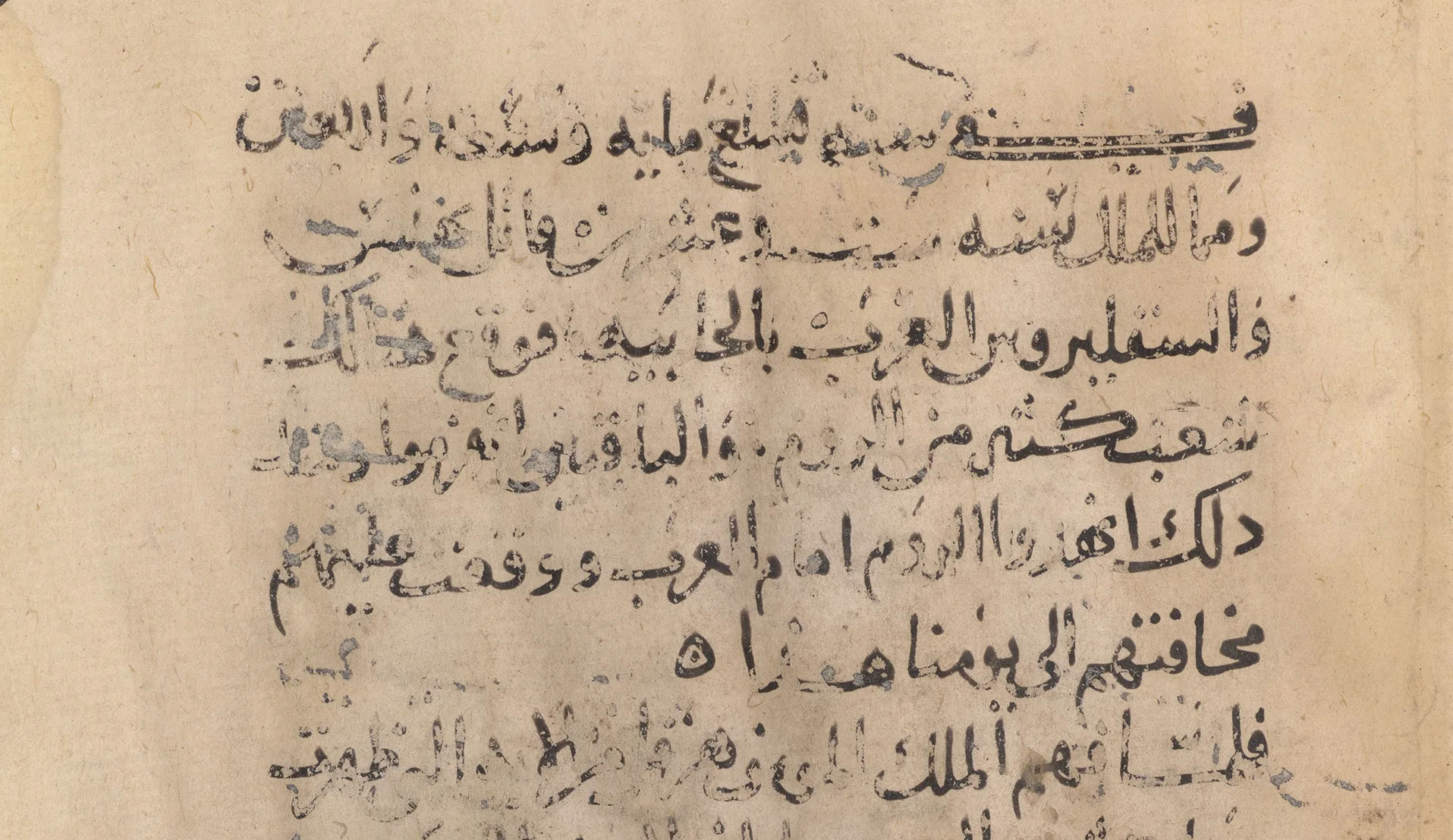
A newly discovered Christian world chronicle from the early eighth century offers fresh insights into the political and religious upheavals from Late Antiquity to the rise of Islam. Researchers at the Austrian Academy of Sciences (OeAW) have discovered and analyzed the work—originally written in Syriac and later translated into Arabic— in a manuscript held at St. Catherine’s Monastery in Egypt.
It is among the earliest surviving Christian sources on the expansion of the Arab-Islamic empire and opens up new perspectives on events in the Middle East before and after the emergence of Islam: a previously unknown world chronicle dating to around 712/713 CE. It describes the political and religious transformations of the seventh century, including the rise of Islam and the Arab–Byzantine wars.
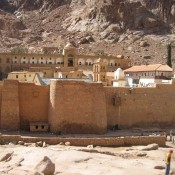
The spectacular find was made by Adrian Pirtea, a historian at the Institute for Medieval Research of the Austrian Academy of Sciences (OeAW), while examining digitized manuscripts from St. Catherine’s Monastery on Mount Sinai in Egypt. Initial results were recently published in the academic journal Medieval Worlds.
A Damaged Manuscript Deciphered for the First Time
The chronicle, originally composed in Syriac and later translated into Arabic, survives only in a single thirteenth-century manuscript, whose pages are damaged and in part stuck together. Thanks to high-resolution digitized images provided by the Early Manuscripts Electronic Library and freely accessible through the Sinai Manuscripts Digital Library, scholars were able to study the work in detail for the first time.
“Since my identification and initial analysis of the text, it has become increasingly clear that this is a previously unknown Christian universal chronicle,” Pirtea explains.
Anonymous Chronicler of the Arab Conquests
In the work, now known as the “Maronite Chronicle of 713,” the anonymous chronicler recounts the entire history of humankind, from Adam to the political and theological debates of his own time. “Written within a Syriac Christian community that was traditionally tied to Constantinople but gradually distanced itself from the Byzantine church due to theological disputes, the work offers a unique perspective on the transformation of the eastern Mediterranean in Late Antiquity and the early Islamic period,” says the OeAW medieval historian.
According to Pirtea, one of the chronicle’s most historically valuable sections concerns the seventh century. It describes the Byzantine–Sasanian War of 602–628, the rise of Islam, the early Arab conquests, and later Arab–Byzantine conflicts. The narrative ends in the years 692–693. Remarkably, the author appears to have been well informed not only about events in Syria and the Middle East, but also about developments in the Balkans, Sicily, and Rome.
A Treasure for Research
Pirtea places the discovery in context: “The chronicle may be closely connected to another, now-lost eighth-century source that was used by several later historians. This opens up a crucial key to reconstructing an entire tradition of early medieval Syriac and Arabic historiography.”
The discovery makes it possible, for the first time, to directly trace a previously lost perspective on the history of the Middle East during the first century of Islam. The OeAW researcher is currently working on a critical edition and a complete translation of the chronicle in order to make the work accessible to the international scholarly community.
Publication: A Hitherto Unknown Universal History of the Early Eighth Century: Preliminary Notes on the Maronite Chronicle of 713, Adrian C. Pirtea, medieval worlds, no. 23/2025, pp. 155-167, 2025/11/27
DOI: 10.1553/medievalworlds_no23_2025s155
 NOTES
NOTES