IPHES-CERCA takes part in this international study that has examined 42 European sites to reconstruct how technological changes emerged and spread during the Middle Pleistocene, giving rise to the Levallois method.
The technological innovations that marked the beginning of the Middle Palaeolithic in Europe did not appear suddenly, as traditionally interpreted. A new study shows that key techniques such as the Levallois method have earlier roots and developed gradually around 400,000 years ago, in a context of favourable climatic conditions and the expansion of human populations.
This is the main conclusion of an article published in Quaternary Science Advances, led by Dr Valentine Rineau (Sorbonne Université), with the participation of Dr Andreu Ollé, researcher at IPHES-CERCA and associate professor at the Universitat Rovira i Virgili, and Dr Paola García-Medrano, researcher at CENIEH. The study, developed within the international NEANDROOTS project, analyses the evolution of technological traditions and cultural diversity in Western Europe around the onset of Marine Isotope Stage 11 (MIS 11, ca. 424–374 ka), a key period in the transition from the Lower to the Middle Palaeolithic and in the emergence of Neanderthal traits.
Overall, the work proposes that the technological innovations of this period reflect a gradual cultural evolution, based on the inheritance and diversification of earlier traditions, rather than abrupt breaks or population replacements. Under a milder and more stable climatic scenario, Middle Pleistocene human populations would have expanded their territories, strengthened contact networks and developed increasingly complex forms of production and technical organisation.
42 European sites
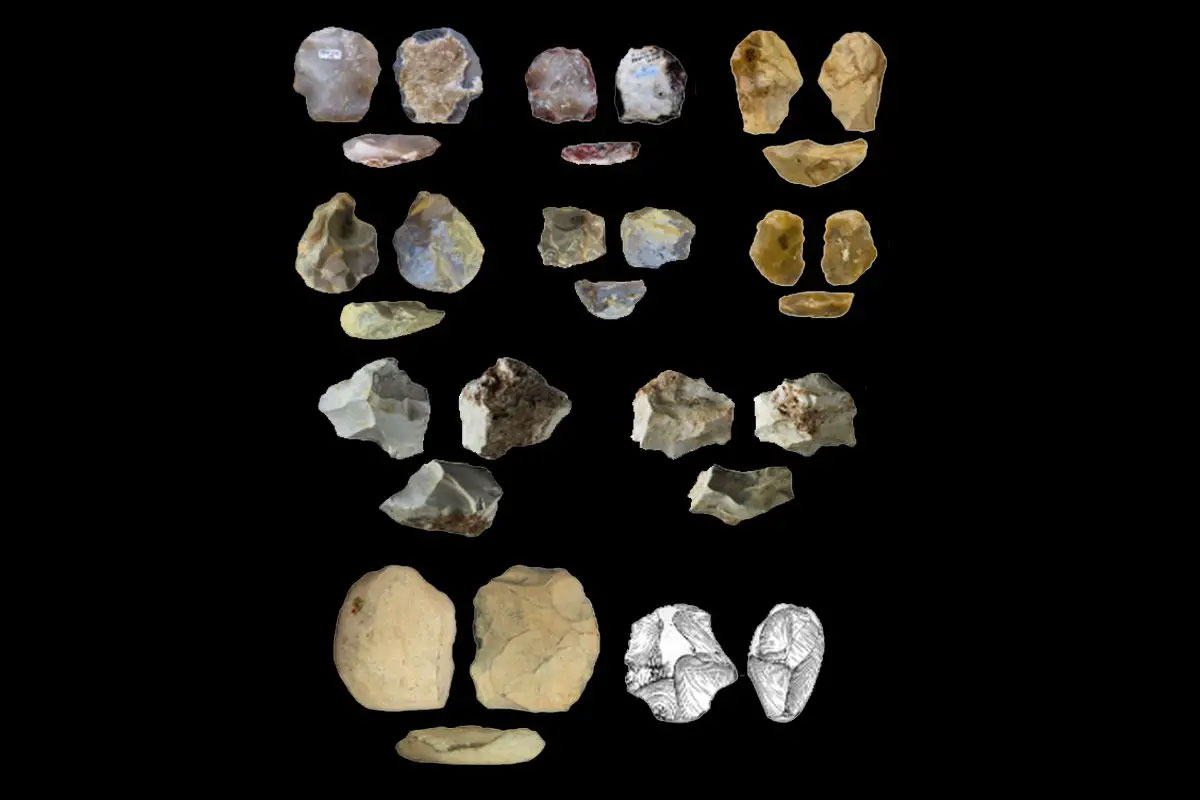
The authors analysed 47 archaeological levels from 42 European sites, from France and Italy to the Iberian Peninsula and Great Britain, including several cases from Central and Eastern Europe. The study focuses on lithic technology: core reduction —including the development of the Levallois method—, large cutting tools such as handaxes and cleavers, and small retouched tools.
To compare these assemblages, the team applied a cladistic approach based on the three-item analysis (3IA) method, commonly used in evolutionary biology. This procedure makes it possible to reconstruct historical relationships based on shared innovations. In the study, each lithic assemblage was treated as a cultural unit, analysing the technological traits it shares with others and its hierarchical organisation, allowing researchers to evaluate which innovations appear, how they combine and how they evolve over time.
The results reveal a hierarchical structure among European sites, with a clear division between predominantly British and continental assemblages. However, within Western Europe there is no evidence of strong regional cultural endemism. In other words, technological traditions were not completely isolated; instead, connections existed between sites in northern and southern Europe, suggesting frequent contacts and population mixing during MIS 11.
One of the most significant findings is that Levallois technology likely already existed before MIS 12, survived the glacial episode and diversified during MIS 11, rather than being a completely new invention of this period. The study also shows an intensification of complex reduction methods, such as hierarchised centripetal and discoid systems, which coexisted with Acheulean traditions such as handaxe production.
The participation of IPHES-CERCA in this study reinforces its contribution to the understanding of technological and cultural processes in the European Middle Pleistocene, as well as its involvement in international projects applying innovative methodologies to study human evolution.
Reference: Rineau, V., García-Medrano, P., Zeitoun, V., Zaragüeta, R., Ashton, N., Arzarello, M., Ollé, A., Lamotte, A., Peretto, C., & Moncel, M.-H. (2026). Technological innovations and regional diversity in Western Europe at ca. the MIS 11 threshold: a cladistic approach. Quaternary Science Advances, 21, 100314. https://doi.org/10.1016/j.qsa.2026.100314
 NOTES
NOTES