An in-depth article has been published in the e-journal of the Pompeii excavations following the recent safety and restoration work on the Thermopolium of Regio V.
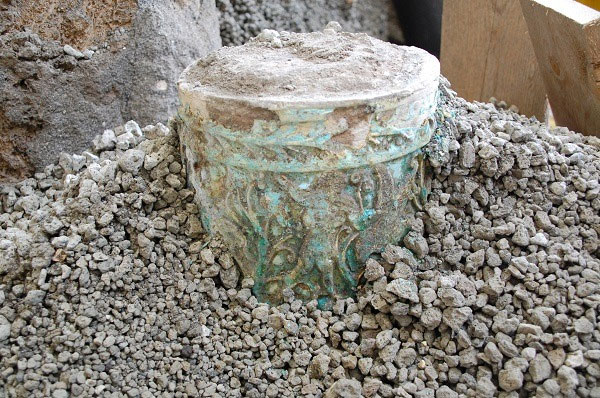
A glass paste vase with Egyptian-style hunting scenes, produced in Alexandria, Egypt, stood in the center of the kitchen of the Thermopolium of Regio V, which was partially excavated in 2020-2021. The glazed container, usually found in the Vesuvian area as a valuable decorative element in gardens and representative environments, had clearly been reused here as a kitchen container. It is hoped that analyses following the ongoing restoration work will reveal its contents.
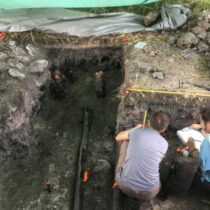
New excavations begun in 2023 in the Regio V area of Pompeii, with the aim of improving the conservation conditions of the rooms adjacent to the Thermopolium. They have brought to light the service rooms and the small apartment on the first floor where the managers of the business lived. In the room on the ground floor with the stove, the tools used for food preparation and numerous wine amphorae of Mediterranean origin were found in situ
“Here we see a certain creativity in furnishing sacred and profane spaces, namely the domestic altar and the kitchen, with objects that testify to the permeability and mobility of tastes, styles, and probably also religious ideas in the Roman Empire. We see this phenomenon here not at an elite level, but in the back room of a popina, a street food restaurant in Pompeii, i.e., at a lower-middle level of local society, which nevertheless proved essential in promoting Eastern cultural and religious forms, including Egyptian cults and, later, Christianity,” explains Director Gabriel Zuchtriegel.
The Pompeii excavations e-journal https://pompeiisites.org/e-journal-degli-scavi-di-pompei/ has published an in-depth article on the construction work that has affected these areas.
At the time of the eruption, the room adjacent to the Thermopolium served as a service area. The spaces were organized in a functional way: a small bathroom was located next to an entrance that opened onto the alley known as the Balconi, while another area was used for storing amphorae and other containers for liquids. The remaining space was occupied by objects used for processing, cooking, and storing food.
Among the most interesting finds recovered was the aforementioned richly decorated glass paste vessel, evidence of the commercial and cultural exchanges that characterized Pompeii.
The upper floor of the service area was divided into two small rooms, one of which was decorated in the Fourth Style, with illusionistic perspective architecture and a yellow-colored floor. The room was equipped with furniture, perhaps partly covered with polychrome marble-clad surfaces, and personal items stored in richly decorated wooden boxes.
 NOTES
NOTES