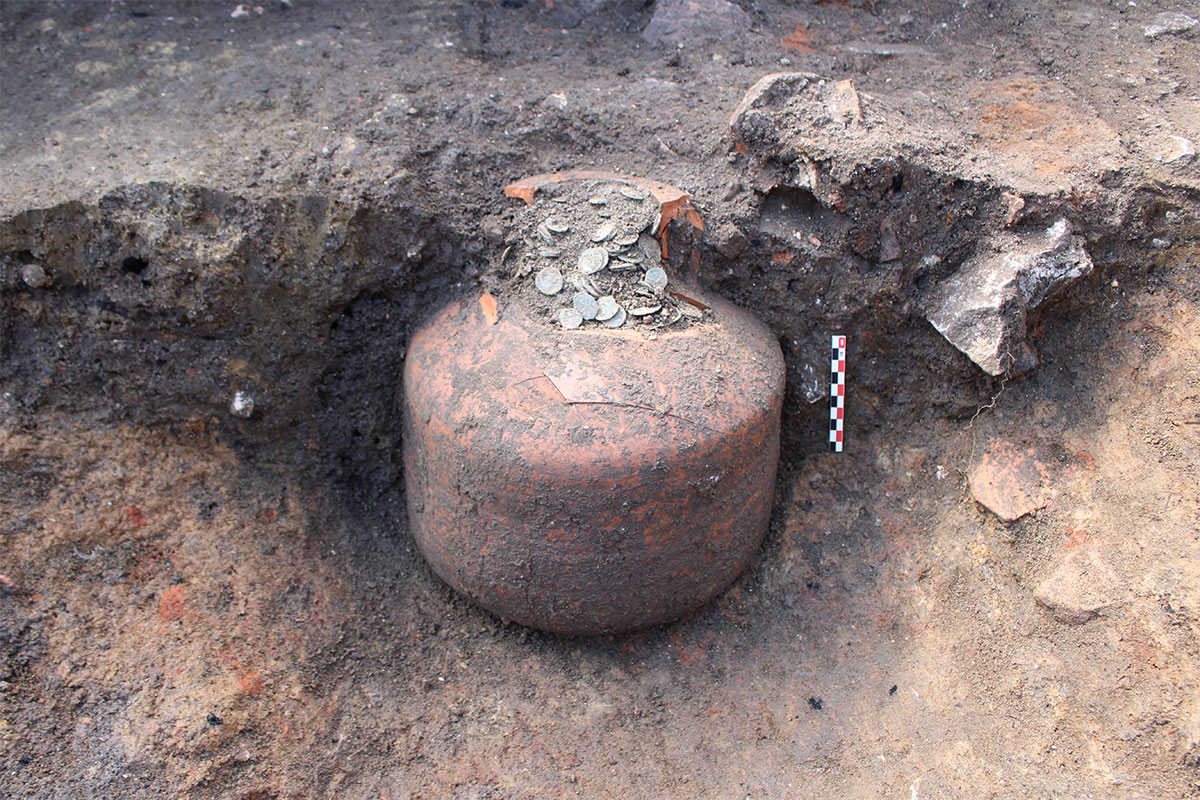
Three amphorae containing around 40000 coins—antoniniani (radiates)—of the period of AD 260-280 were discovered by the National Institute for Preventive Archaeological Research (Inrap) in Senon, France. Among issuers, Victorinus, Tetricus I and Tetricus II.
One of the most significant and puzzling discoveries of the excavation is the finding of three coin hoards buried in this residential district during Late Antiquity. The Regional Archaeology Service directed prior archaeological monitoring to locate the first, while the Inrap intervention found the other two. All three present similar characteristics: several thousands of coins dated between the last quarter of the 3rd century and the first decade of the 4th century CE, contained in large ceramic vessels—large jars or amphorae—placed in pits excavated within the houses.
Contrary to what a preliminary interpretation might suggest, it is by no means certain that these are “treasures” hastily hidden in a context of insecurity. Archaeologists consider other hypotheses and prefer to see these sets as a snapshot of a complex monetary management, designed for the medium or long term, within a household or administration, making deposits and withdrawals on various dates.
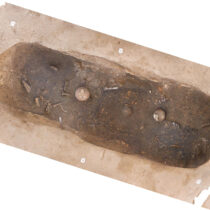
Observations during the excavation do not reveal a rushed concealment; the vessels were carefully placed in well-prepared pits, perfectly vertical and secured with packing stones. In two cases, some coins adhering to the exterior of the vessel wall clearly indicate that they were deposited after the vessel was buried, before the pit was fully filled with sediment.
Finally, the location of the two hoards found during the excavation, in seemingly ordinary living rooms and at a level very close to the period floor—the necks of the vessels nearly flush with the ground—indicates that they remained accessible to their owners. The fire at the beginning of the 4th century marks a significant disruption—witnessed, among other things, by the forgetting of the coin hoards—but not the end of occupation of the district. The houses were rebuilt, relying on the foundations of preexisting walls; old cellars were reoccupied, and floors were levelled and refurbished, sometimes with considerable care, using stone or reused tile flooring.
 NOTES
NOTES