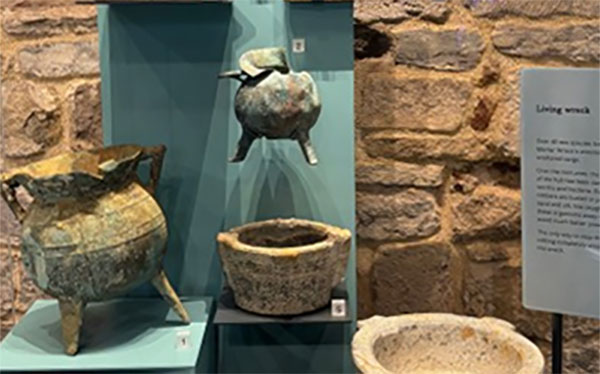
The earliest English medieval shipwreck to be discovered by Bournemouth University (BU) Maritime Archaeologists off the coast of Studland in Poole Bay back in 2020 has been turned into a display at Poole Museum, which is now open to the public for the first time after a seven-year, £10 million heritage-led regeneration project.
Visitors to the museum can learn about how the 13th Century old was first discovered by local charter boat skipper Trevor Small of Rocket Charters in Poole Bay on the edge of the Swash Channel, and how Maritime Archaeologists from BU helped to uncover its history.
BU’s Maritime Archaeologist, Tom Cousins, who led the project and organised multiple dives to the wreck site to raise the contents of the ship to the surface said: “Bournemouth University is in a unique position situated next to one of the oldest harbours and maritime trading routes in the UK. We are fortunate to be able to discover wrecks as old as the medieval Mortar Wreck. Seeing the cargo and items that on display in Poole Museum is a great testament to the last twenty years’ work by the Maritime Archaeology Department at BU.”
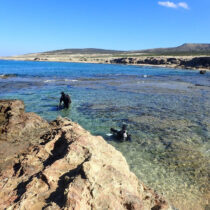
BU Archaeology students also got the chance to dive the Mortar Wreck during their course as Tom said: “As part of our general archaeology degree programme we teach students how to dive. In their second year they have the option to dive these wrecks, and this year we took a group of students out to the Mortar Wreck to practice their survey skills and learn how to become a scientific diver.”
The contents of the ship included several Purbeck stone mortars, which are large stones used in mills to grind grains into flour. Two Purbeck marble gravestone slabs were also found in the wreck in remarkably good condition. These items are now on display at Poole Museum in a new exhibition called the ‘Mortar Wreck’ exhibition.
Joe Raine, Collections Officer at Poole Museum said: “We’re really lucky to have a great collaboration with Bournemouth University here at Poole Museum in that we are the receiver for a lot of the artefacts that they bring up from the wrecks they find. When we first heard about the discovery of the Mortar Wreck we were just so excited to play our part in the whole story which is to put the items on display to members of the public who may know nothing about the trade in Purbeck stone, or medieval seafaring, and we can tell that story.”
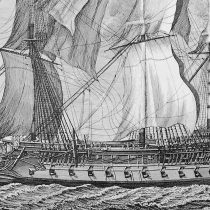
Members of the public can now learn more about how trading of Purbeck stone took place in the mid 1200s and the vessel itself. This is known as a ‘clinker’ ship, which is made from overlapping planks of wood. Several of the planks have been sent for testing where tree ring analysis indicates that the timbers used to construct the hull are from Irish oak trees, felled between 1242-1265.
In a special episode, to be broadcast on Saturday 29 November, the ‘Time Team’ television series, now on YouTube, will feature the work from first discovering the wreck in 2019, identifying it in 2020 to analysing it, bringing up the contents and displaying them in the museum in 2025. The ‘Time Team’ crew, presented by Derek Pitman, also Associate Professor at BU have spent three years following the work of the BU Maritime Archaeologists. Derek said: “One of the best experiences of my life was sitting on that boat, watching a live feed of Tom, as he gave me a tour underwater, and we got to incorporate that in the episode as well. So, the viewers can follow me being taken on a grand underwater tour by one of the best experts in maritime archaeology.”
The Mortar Wreck exhibition is now on display at Poole Museum, which is open daily from 10am to 5pm and is free admission.
For further information about Bournemouth University’s Archaeology and Anthropology courses please visit the BU website.
To watch the 2022 interview with Tom Cousins please visit the Bournemouth University YouTube channel.
 NOTES
NOTES