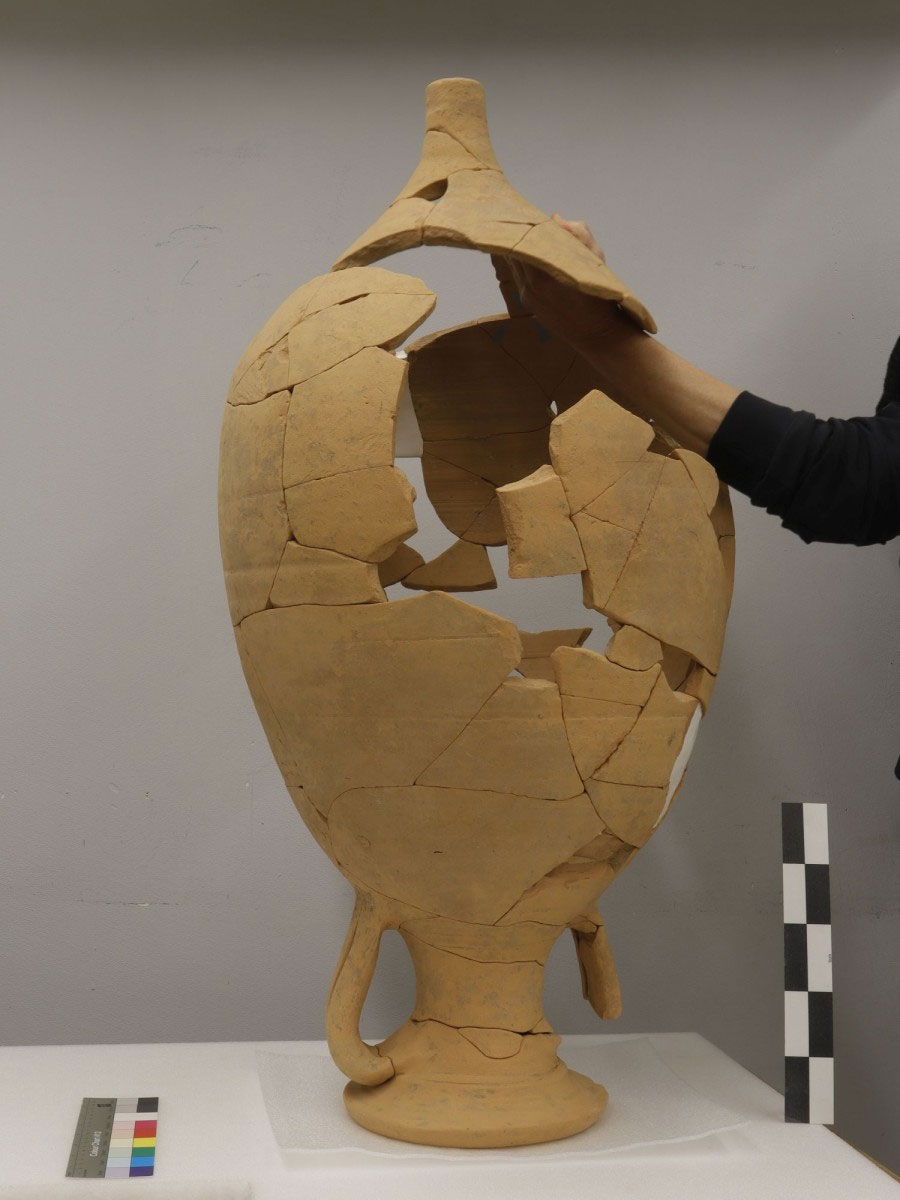
The post-excavation analysis of the rescue excavation by the Cantonal Archaeology in Gebenstorf has produced some initial results. The Roman building complex on the Limmat was not only a hub for goods transshipment but also a political and legal center within the sphere of influence of the Roman Empire. Among the finds was a complete amphora with remnants of its contents. These provided the first evidence that sardines were consumed in Roman Switzerland.
The post-excavation work of the rescue excavation by the Cantonal Archaeology in Gebenstorf will be completed by the end of the year. The 14-month excavation, carried out between April 2024 and May 2025, generated extensive documentation of Roman remains south of the Limmat: descriptions of over 4,000 archaeological structures, nearly 800 plans, and over 2,600 photos have so far been recorded in the database of the Cantonal Archaeology. The excavation team recovered 1,665 artifact assemblages, including a total of 137 coins and various rare items such as weights, lead weights, styli, and a small folding ruler. The structures and finds confirm that during the time when legions were stationed in Vindonissa, a trading and storage hub existed at what is now Gebenstorf-Steinacher.
Rome on the Limmat
The scientific post-excavation work now allows for more precise statements and a first visualization of the large building complex on the Limmat, which consisted of three structures and was likely built towards the end of the 1st century AD by detachments of the Legion XI. The western building was a two-aisled pillared hall with front porticos (covered walkways). The central building featured a cryptoporticus, a mostly subterranean walkway commonly found in Roman forums (marketplaces). The eastern building had a complex floor plan with several rooms, entrances, corridors, and courtyards. This distinguishes it clearly from the other two large buildings. The southern ends of all three buildings lie outside the excavation area and may still be preserved beneath today’s cantonal road. Thus, the site on the Limmat was probably not just a transshipment point but also a political and legal center—possibly even planned as a city-like settlement.
Roman amphora with contents
But it wasn’t only the monumental buildings that were remarkable—the finds also brought surprising new insights. Among thousands of broken amphorae, the excavation team documented a single fully intact specimen of this typical ancient transport container. Already in the field, it was noted that the belly of the amphora contained a strange gray-white sediment. The entire find complex was recovered as a block and brought to the restoration lab of the Cantonal Archaeology, where the sediment was carefully packaged and sent to the University of Basel. There, the remains were analyzed in the lab of the Institute for Integrative Prehistoric and Natural Sciences.
The sediment was washed through several fine sieves. What remained were tiny bones of marine animals from the liquid that had once been inside the amphora. It was fish sauce—one of the most popular condiments of the ancient world. Ancient sources refer to it with various names, such as flos liquamen, (h)allec, muria, salsamenta, and the best-known term, garum. These terms denote different qualities of fish sauces.
First Evidence of Roman-Era Sardines in Switzerland
The bones consisted primarily of remains (bones, scales, vertebrae) from Sardina pilchardus, also known as the Atlantic or European sardine. This marine fish is relatively widespread, found in the northeastern Atlantic and the Mediterranean. Sardines form large coastal shoals and remain an important food fish to this day. The remains from the amphora came from very small specimens, under ten centimeters in length. This is the first-ever evidence of sardine remains in a Roman-era site in Switzerland.
The Romans were among the first societies to extensively exploit fish resources and built large salting and preservation facilities to produce fish sauces. Small fish were fermented in these installations, and the resulting sauce was stored in amphorae for trade across the Roman Empire. A more precise identification of the sardines’ fishing region would require population genetic studies, which are, however, quite complex.
However, the amphora itself can also provide clues to its place of origin. An amphora specialist from the Cantonal Archaeology examined the fragments. Based on the clay quality, the amphora—and likely its contents—was produced on the coast of the Roman province of Baetica, in what is now Andalusia. However, an origin from Gaul, in the area around present-day Lyon, cannot be entirely ruled out. The amphora and its contents were likely produced and traded between about 25 and 50 AD, according to form comparisons.
Documentary Film Now Online
A documentary film by the Cantonal Archaeology now provides insight into the 14-month excavation and presents the initial results. The film is available online as of now.
 NOTES
NOTES