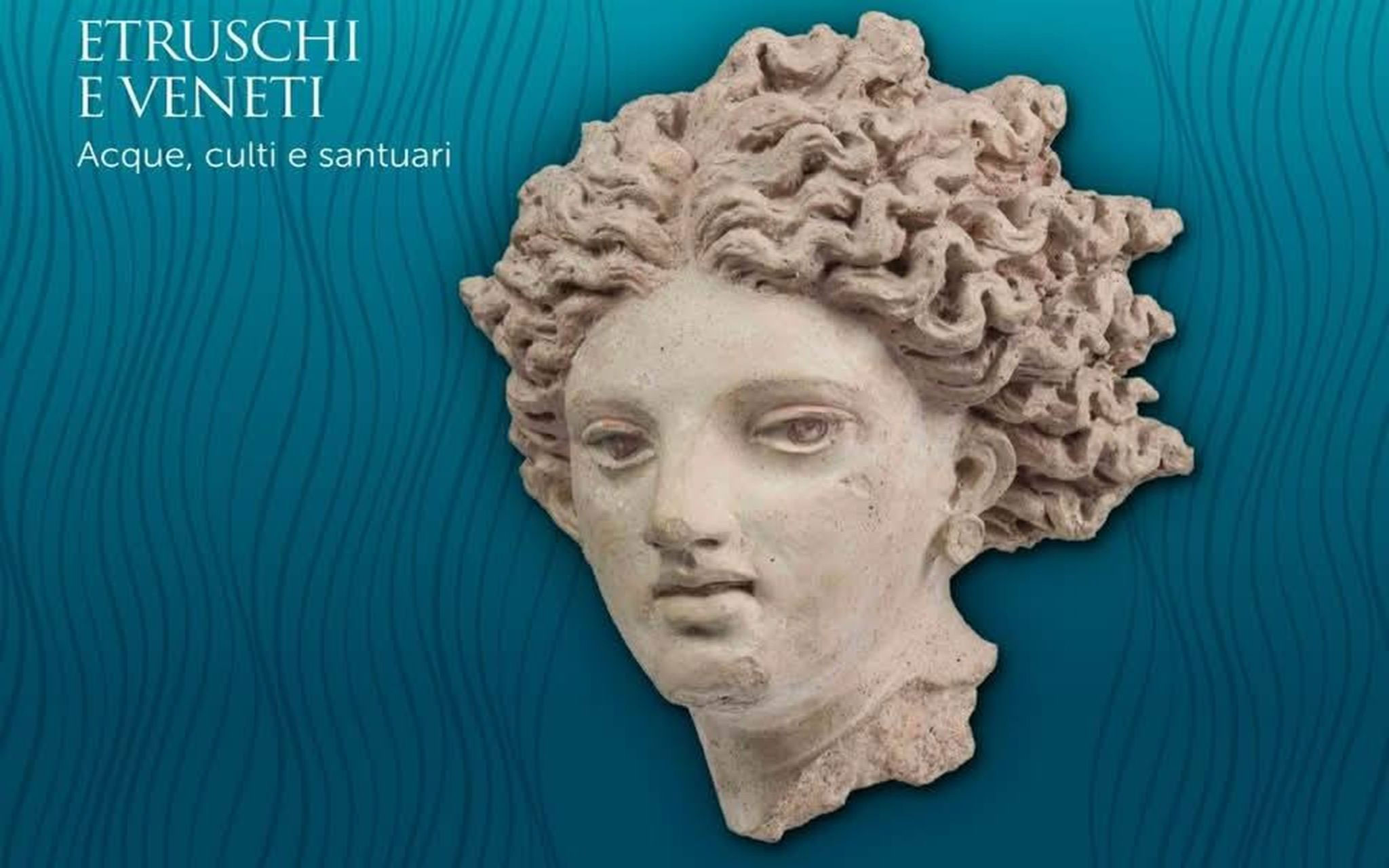
The new exhibition Etruschi e Veneti. Acque, culti e santuari, hosted in the rooms of the Doge’s Apartment at the Doge’s Palace from 6 March to 29 September 2026, takes as its starting point the concept of the sacred in the Etruscan world, examining the many forms and expressions of worship connected with water.
Seas, rivers, lakes and springs emerge as the preferred locations for the construction of sanctuaries dedicated to water cults. The section devoted to the Etruscans begins with the sanctuaries of the Tyrrhenian ports of Vulci and Pyrgi, continues with the sanctuaries of healing waters at Chiusi, Chianciano and San Casciano dei Bagni, and includes the small yet monumental sanctuary of Marzabotto, built in the heart of Etruria Padana in correspondence with a natural spring. The Etruscan section concludes with artefacts from Adria and Spina, the most important ports of the northern Adriatic, where the presence of places of worship is not attested by monumental structures but solely by epigraphic and archaeological evidence.
The exhibition itinerary then moves into the territory of the ancient Veneti. The theme of the sacred in the local context and its relationship with water is introduced through materials that guide visitors into the religious sphere of the Veneti: San Pietro in Montagnon, present-day Montegrotto, closely associated with the healing power of thermal waters; the Dolomite sanctuary of Lagole di Calalzo, linked to springs believed to possess therapeutic properties; and the sanctuary of Este, located along a branch of the Adige River and dedicated to Reitia, the river goddess.
The final stop of the exhibition is the lagoon sanctuary of Altino, a port facing Adriatic and Mediterranean routes that functioned as an international maritime outpost for the Veneti people, where distinctive rituals developed through the integration of foreigners.
The exhibition concludes with a previously unseen contemporary tapestry by Giovanni Bonotto, which, through the universal and timeless theme of water, establishes a bridge between past and present.
The exhibition is organized by the Fondazione Musei Civici di Venezia, under the patronage of the Istituto Nazionale di Studi Etruschi e Italici, and in collaboration with the Fondazione Luigi Rovati of Milan, where it will be reinstalled after the Venetian venue.
Admission to the exhibition from 6 March to 29 September 2026, with the museum’s opening hours >
Curated by: Chiara Squarcina, Margherita Tirelli
In collaboration with: Fondazione Luigi Rovati
With the patronage of: Istituto Nazionale di Studi Etruschi e Italici