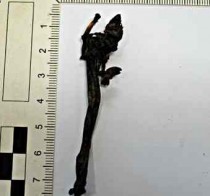
A volunteer collaborator, Sacha Schneider, discovered a massive bronze axe and a dress pin at Burg im Leimental. A bronze sickle had already been found here in 1858. The objects were likely deposited about 3,500 years ago as offerings to deities. It is possible that they originally formed part of a larger hoard.
A new discovery nearly 170 years later
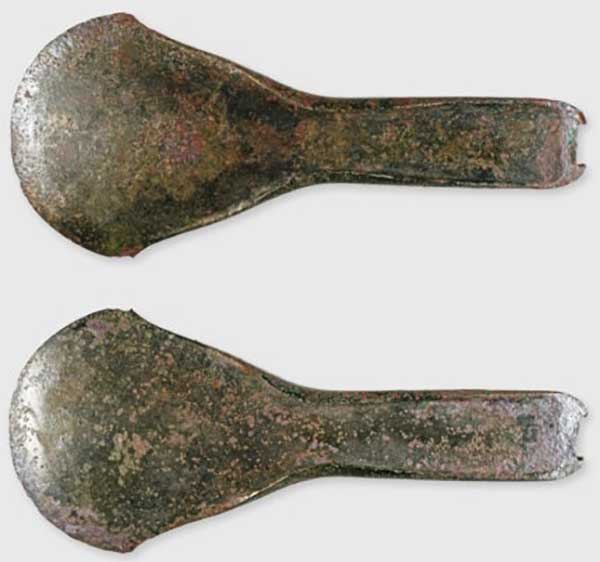
In his 1864 chronicle of the Bernese Jura, local historian Auguste Quiquerez reports that a bronze sickle was discovered in 1858 near Biederthal Castle (Burg i. L.). In the summer of 2024, Sacha Schneider, a field scout for Archaeology Baselland, conducted a metal detector survey on the steep slope of the castle rock formation. During this work he discovered a massive bronze axe approximately 22 centimeters long and, some distance away, a dress pin. All the objects date to the Middle Bronze Age, around 1500 BCE.
Comparisons lead across the Jura to Grenchen. There, in 1856, the expansion of a spring revealed a deposit containing four axes, four sickles, and a fragment of a sword. Since then, the specific form of these so-called flanged axes has been referred to as the “Grenchen type,” named after the place where they were first discovered.
The phenomenon of hoard deposits
The deposition of multiple metal objects was a widespread phenomenon during the Bronze Age. In some cases, more than a hundred objects were deposited within a very small area. Different categories of items—such as tools, weapons, and jewelry—are often found together. Research suggests that such hoards were deliberately buried. In most cases they are interpreted as votive offerings to unknown deities.
Single bronze objects discovered in special locations—within rock crevices or in the water—are interpreted in a similar way. The axe from Burg was likewise found lodged in a rock pocket filled with soil and could therefore represent an individual offering. However, since additional bronze objects have been discovered at the same location, it cannot be ruled out that they were originally part of a larger hoard that was later looted or dispersed.
A region of particular significance?
The small village of Burg lies on the border between Switzerland and France. Its present-day peripheral location should not obscure the fact that this is a very fertile region with strong connections to the Rhine and Rhône valleys (the Belfort Gap). Finds from nearby Rodersdorf show that people settled here during the Middle Bronze Age.
Another bronze axe of the Grenchen type was discovered in 1968 during the construction of the Aesch swimming pool and may indicate a route leading into the Birstal. In Biederthal (France), about one kilometer from the findspot in Burg, a large Bronze Age hoard was uncovered in 1998. It is currently on display in the exhibition Treasure Hoards at the Historical Museum Basel. Evidently, the zone between the flat Sundgau and the northernmost foothills of the Jura held particular significance for the people of that time.
The bronze finds from Burg are now on display—together with recently discovered Celtic gold and silver coins from Arisdorf—in the special exhibition Treasure Hoards at the Historical Museum Basel (Barfüsserkirche).
 NOTES
NOTES