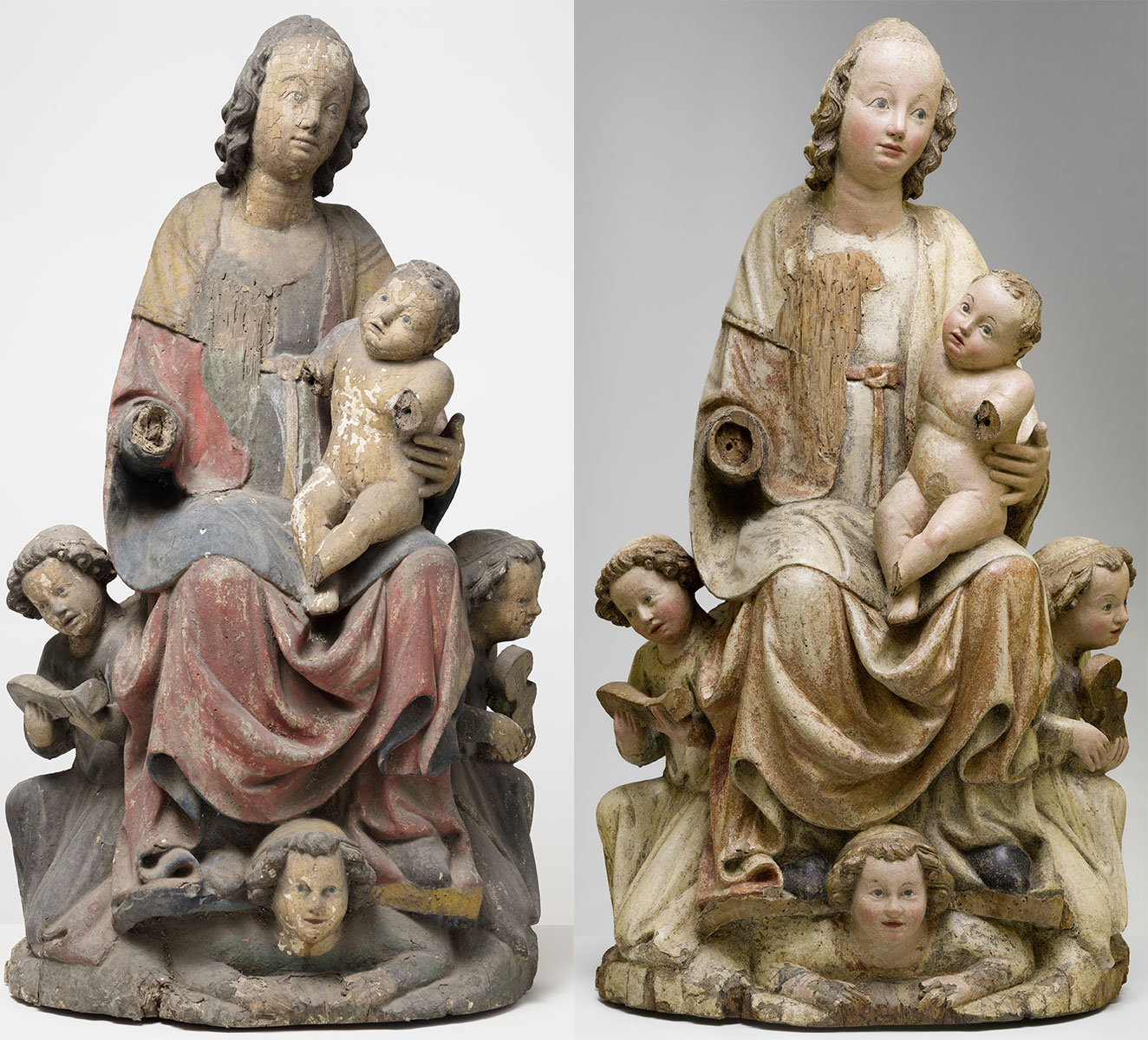
Thanks to funding from the Ministry of Culture of the Czech Republic, the National Gallery in Prague has acquired a unique medieval sculpture — the Madonna on the Angelic Throne or Madonna of Havraň (also called Madonna with Music-Making Angels) — from private ownership three years ago. The rare wooden sculpture is attributed to the Master of the Bečovský Madonna. After its painstaking restauration it has now gone on display at the Convent of St. Agnes of Bohemia in Prague.
The National Gallery in Prague acquired the Madonna in 2022 for CZK 4.5 million (approx. €180,000).
It is extremely rare for an unknown 14th-century sculpture to surface in the Czech Republic. This piece depicts the Madonna as the Queen of Heaven, or Queen of Angels. It shows the Virgin Mary seated on a throne and holding the baby Jesus. The throne is being lifted by three music-playing angels. She wears a gown tied at the waist and an outer cloak. Her face is marked by a high forehead, a small nose, delicate lips, and a slightly protruding chin. “She also wore a veil, which covered part of her hair and draped down to her chest. It was probably cut away and replaced with a metal crown. And the child Jesus received a metal crown as well,” restorer Markéta Pavlíková from the National Gallery in Prague (NGP) said.
Looking at the artistic and historical features of the statue, experts have determined that it fits into a known group of sculpture, the enthroned Madonnas, which demonstrate the sophistication of Prague’s artistic center during the reign of Charles IV. Comparisons allow it to be dated to the 1360s–1370s. This dating is further supported by the musical instruments held by the angels — the quiterna (a stringed instrument like a lute but with a flat back). and the fiddle — which were commonly used by musicians of that era.
In the 19th century, the Madonna was located in the Church of St. Lawrence in Havraň near Most.
“The Madonna on the Angelic Throne from Havraň by the Master of the Bečovský Madonna is a unique 14th-century sculpture, and I am truly delighted that, thanks to the Ministry of Culture’s funding, it has found its way into the National Gallery’s collection. It is incredibly rare for such an old and previously unknown sculpture to appear on the market. It is even more of a celebration when such a beautiful and important work is acquired by the state,” Minister of Culture of the Czech Republic Martin Baxa said.
 NOTES
NOTES