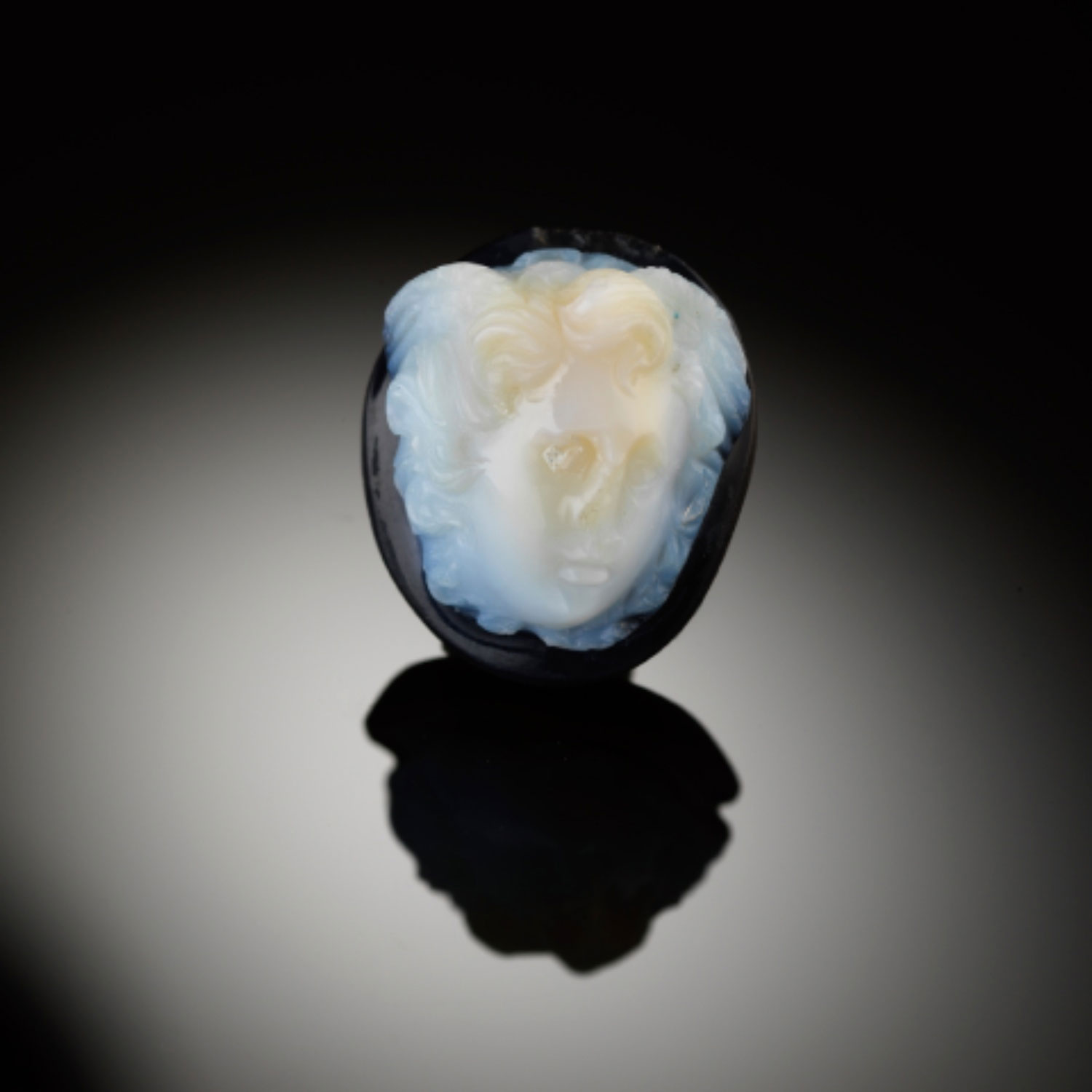
The Medusa of Hallstatt may only be about 1.5 cm tall, but it is one of the most significant individual finds from Roman antiquity in Upper Austria. This exceptionally high-quality piece of jewelry is a cameo, probably made in the 2nd century AD in Aquileia on the northern Adriatic coast. It was discovered in June 2025 during excavations by the excavation company ARDIS and the Upper Austrian State Museums (OÖLKG) on behalf of Salzwelten GmbH in the area of the valley station, right in the heart of the former Roman settlement.
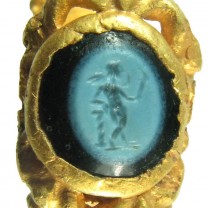
The head of Medusa was carved from a black and white banded agate – also known as onyx. It is only the third Roman cameo to be on display in Upper Austria. A gold finger ring with a lion cameo is exhibited in the Wels City Museum – Minorites, and a gold ring depicting the bound Cupid is on display in the Lauriacum Museum.
The Medusa from Hallstatt is larger than the two cameos from Wels and Enns, and the relief is also more elaborately worked. The oblique view is probably due to the shape of the rough onyx available to the artist. The cameo would be very large for a ring; a setting in an earring is conceivable, but it is more likely that it once adorned the necklace of a wealthy Roman woman.
The Romans and salt
For over 7,500 years, the salt mined in Hallstatt has shaped the region. This “white gold” was for a long time one of the most important preservatives, and control of this precious commodity was associated with prestige and wealth. Finds from the Bronze Age and the early Iron Age (“Hallstatt period”) in the salt mine and the high valley have made the site world-famous. Mining activity is also documented for the Late Iron Age (“La Tène period”), and there is evidence of settlement activity on the so-called Dammwiese (dam meadow).
The Romans, who by the mid-1st century AD had taken control of the area of present-day Upper Austria as far as the Danube, exploited all the raw materials relevant to them. Rome therefore likely laid claim to the Hallstatt salt very quickly. Current research suggests that mining continued in the tradition of the late Iron Age, but that the Romans took over the administration of the site and thus the distribution of the “white gold.” For this purpose, they established a settlement (vicus), the center of which was located in the area of the present-day valley station. Despite numerous excavations, our knowledge of the settlement’s appearance and size is limited, and its ancient name has not been preserved.
The Roman settlement of Hallstatt
The first reports of Roman artifacts from Hallstatt date back to the early 19th century. Between 1858 and 1860, under the direction of Johann Georg Ramsauer, Roman burial grounds were excavated along the Echerntalweg trail; these grounds had once contained impressive funerary monuments. In 1983, six more graves were investigated.
At the end of the 19th century, remains of the associated settlement were first uncovered in the area of today’s valley station. However, the most extensive findings are thanks to Friedrich Morton, who seized every opportunity from the 1940s to the 1960s to gain new insights. Renovation work in the valley station area in 2015 enabled a major excavation by the Upper Austrian State Museum and the University of Innsbruck. The current master plan for Roman Hallstatt is also based on this research. The 2025 excavations continued the 2015 excavation and resulted in minor additions.
Opposite the entrance to the Culture and Congress Center is the Janu sports shop. In its basement, among other things, the remains of a massive Roman building can be viewed. It is quite possible that a Roman villa was also located in the area of today’s town center.
Myth of Medusa
The sea deities Phorkys and Keto had three daughters, also known as Gorgons. One of them was Medusa, the only mortal Gorgon. “This one the prince of the sea dishonors… in Minerva’s temple,” as Ovid writes in his Metamorphoses. Her extraordinary beauty was Medusa’s downfall. Neptune (Greek: Poseidon) raped her in a temple of Minerva (Greek: Athena). The goddess of wisdom and strategic warfare, however, did not take revenge on her uncle but on the innocent Medusa, transforming her into a monster with wings and snakes for hair, whose mere sight caused instant petrification. The goddess Minerva was also involved in Medusa’s death. She provided the hero Perseus, who had been tasked with killing the Gorgon, with a mirrored shield. The indirect view prevented petrification, and thus Perseus was able to behead Medusa. The severed head became Perseus’ superweapon.
The winged head of Medusa, framed with snakes for hair – also known as the Gorgoneion – is an extremely popular motif in Greek and Roman antiquity. It is considered a protective symbol meant to ward off misfortune. And so it can be found in and on buildings, monuments, weapons, jewelry, and much more. Whether the Medusa of Hallstatt brought its owner good luck is impossible to say, but it is certainly a stroke of luck for archaeology in Upper Austria.
 NOTES
NOTES