Two archaeological excavations were conducted within the Palace of Versailles: one on the northern terrace, the King’s side, and the other in the inner courts of the Queen and the Dauphin, on the southern side. Apart from the medieval remains of earlier occupations, the evidence collected makes it possible to document the phases of development, construction levels, and successive transformations of one of the most famous castles in the world, starting from Louis XIII’s hunting lodge in the 1630s all the way to the modern phases of the first half of the 20th century.
The Queen’s and Dauphin’s courts
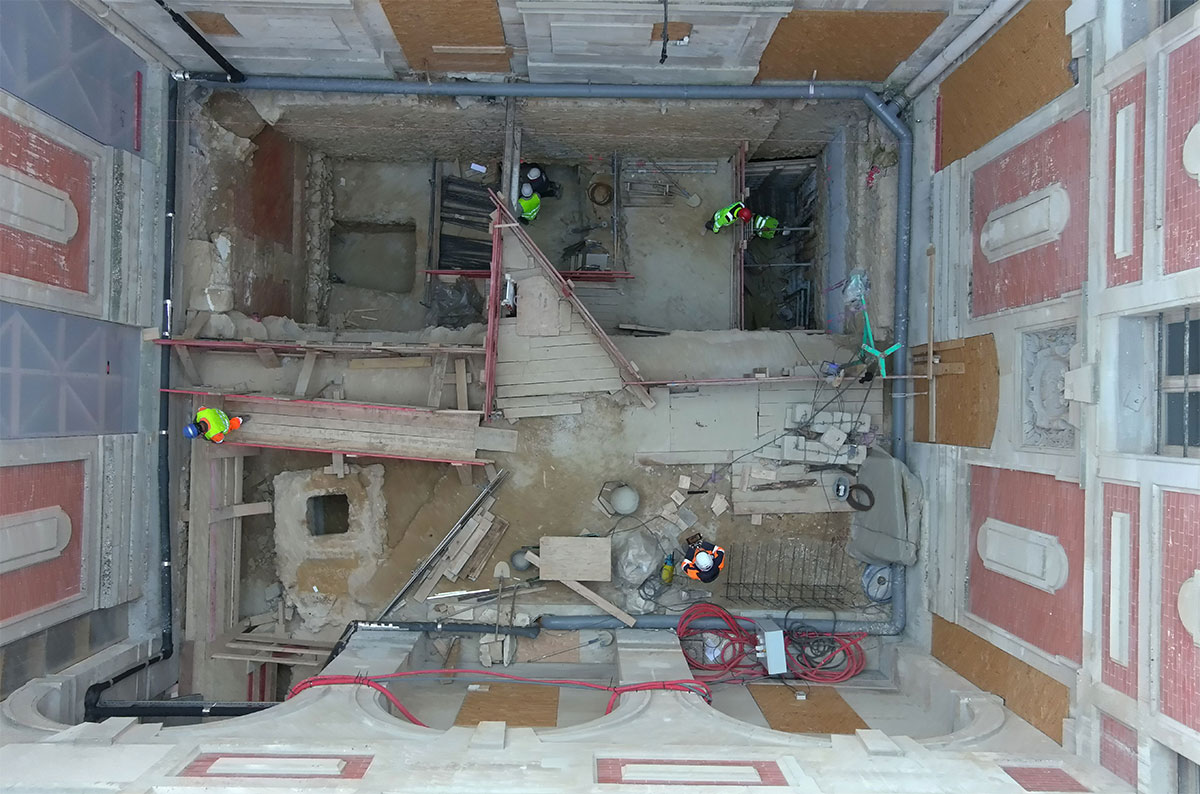
The two courtyards are located at the heart of the Queen’s apartments, in the central southern wing. This wing was built on top of the filled moat of architect Le Vau’s original 1630s hunting lodge, which would later become the first château of Louis XIV. Archaeologists therefore focused on studying the moat-filling levels down to the sandy substrate at a depth of 3.2 meters. Among the remains uncovered were foundations of colonnaded galleries which no longer exist, stone drainage systems, vaulted hydraulic passages, monumental rainwater collectors, and semicircular vaults from the late 17th century. The density of structures in both courts and the clear stratigraphic record will allow a precise reconstruction of the architectural evolution of these spaces.
The Le Vau Wall from the 1660s
The excavation also uncovered all the preserved sections of the brick and limestone counterscarp (inner moat wall). Built in the 1660s, this masonry covering of the internal part of the moat is preserved in only a very few spots of the château. From this initial phase of occupation, a few ceramic pieces were recovered, directly linked to royal elite consumption: a fragment of Chinese porcelain, whose importation to Europe was just beginning, and white and blue faience sherds, decorated with plant and bird motifs from a chamber pot.
The Grande Court and its basin
The excavation also revealed the remains of a large circular basin, placed between 1668 and 1690 at the center of the original Grande Court, before it was split into two distinct spaces by the construction of an added pavilion on the southern wing. The construction type of the basin, with a vaulted service gallery, indicates it was an ornamental basin. Further information is expected to be found in archival records with the support of the Service des Fontaines.
The remains of the Northern Terrace
Recent excavations on the North Terrace of the Château de Versailles, overlooking the parterre of the same name, have provided valuable insights into the construction phases and transformation of the palace over time. These works, carried out in conjunction with ongoing renovations, revealed important remnants of the site’s architectural history including its hydraulics.
Along the façade, archaeologists identified a series of filled hollow structures containing plaster and monumental sculptural fragments—such as a hand, a horse’s jaw, and a ram’s head—dating from the 17th and 18th centuries. These fragments were likely deposited during 20th-century refurbishments of the bas-reliefs located above the palace windows.
Several pits were also uncovered in the same area. These predate the existing masonry and were filled with mother-of-pearl and shell debris, which archaeologists believe to be refuse from the demolition of the Grotto of Tethys, a once-celebrated feature of thepalace that was demolished in 1685 to make way for the north wing.
Additional discoveries include a small, square vaulted structure—probably a sump—located in the southeast corner of the terrace. Together with other hydraulic features found nearby, this structure points to the presence of a sophisticated 17th-century water-management system, originally designed to supply the palace’s fountains and gardens.
Monumental reuse
A 15-metre-long foundation wall made up of reused baluster stones was also uncovered. Though at first the team thought these might come from the demolished grotto, current analysis suggests they most likely belong to an earlier railing or staircase.
The foundation wall might correspond to a barrier, illustrated in a design by Ange-Jacques Gabriel. The first barrier, erected in the 1680s, was altered several times, notably in 1771, to separate the public gardens from the carriage routes leading to the royal apartments.
 NOTES
NOTES