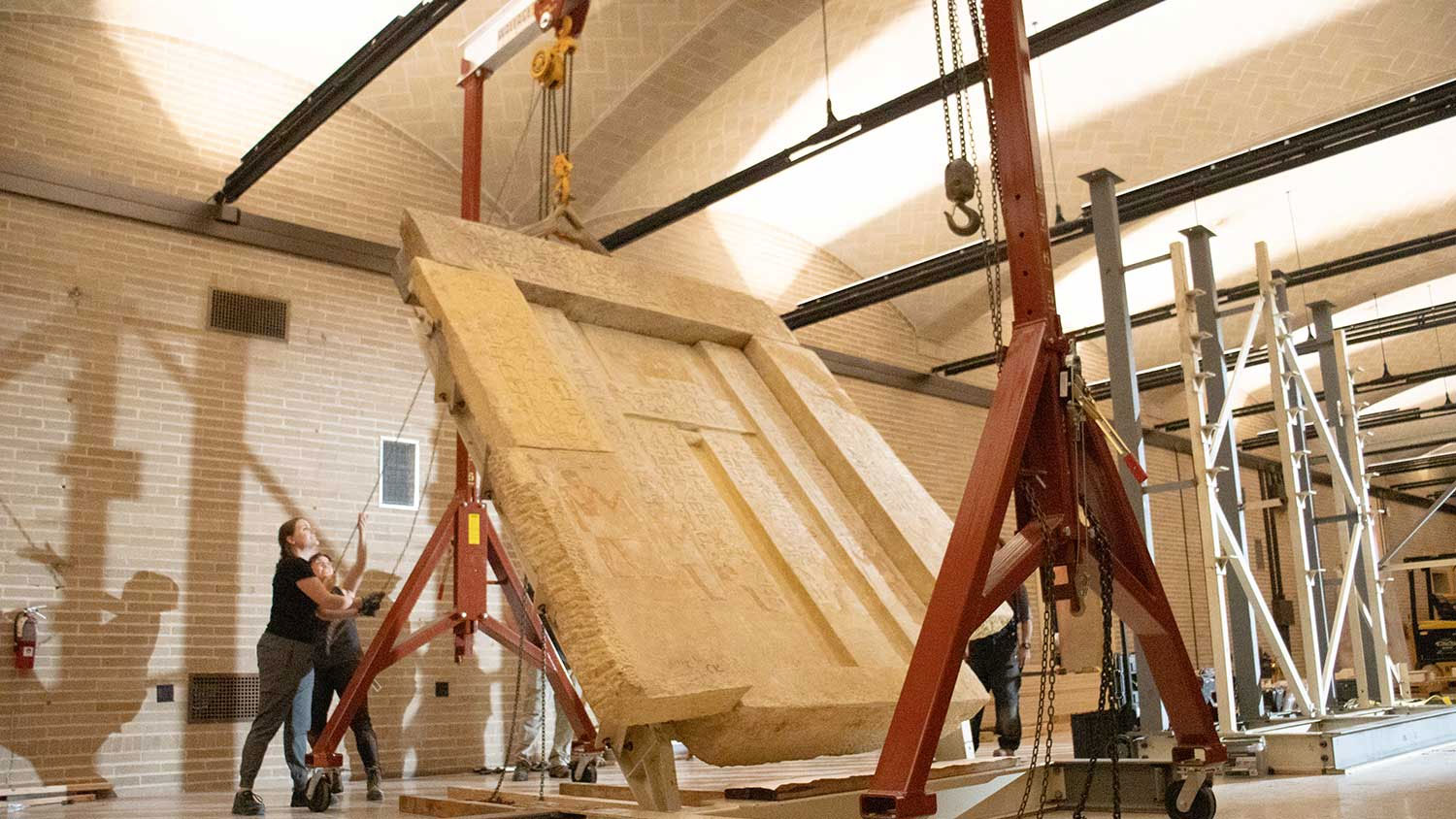
A team of conservators and engineers from the Penn Museum have installed a massive 5-ton “false door” from the 4,300-year-old Tomb Chapel of Kaipure. Over the next few weeks, nearly 100 carved and painted limestone blocks will be added to reassemble this architectural marvel, which has not been on public view at the Museum since 1996.
The offering chamber will serve as the dramatic centerpiece of the highly anticipated Egypt Galleries: Life and Afterlife on the Main Level, which will open to the public in late 2026.
Excavated more than a century ago at Saqqara, the Tomb Chapel was the place where priests performed funerary rites and presented offerings to sustain the deceased in the Afterlife. The “false door” provided a symbolic doorway through which the deceased’s spirit would access the offerings.
“There are not many museums in the United States with such a well-preserved ancient building like the Tomb Chapel of Kaipure—a highlight of the Penn Museum’s collection,” explains Egyptologist and Lead Curator Dr. Jennifer Houser Wegner. “One of the curatorial goals of the Egypt Galleries: Life and Afterlife is to humanize the ancient Egyptians, helping visitors to see them not as distant or exotic figures, but as real people. The individuals who made these artifacts, carved the stone, and painted the statues were people, just like us.The people these objects are commemorating were once living, breathing people who had jobs, fell in love, ate and drank, had families, worried about troubles. and celebrated joys, just like we do,” she adds.
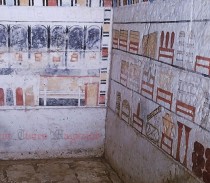
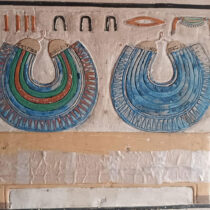
Following extensive conservation across nearly three decades, the tomb chapel and its “false door” now more vividly display hieroglyphic inscriptions and remarkable scenes of daily life, offerings, and rituals, as well as representations of the individual buried in the tomb, Kaipure, a high-ranking treasury official of Egypt’s Old Kingdom (ca. 2350 BCE). Once completed, visitors will be able to move through the monumental structure and experience what it feels like to be inside an ancient tomb chapel.
“To preserve the experience of going into a large space like the funerary chapel, the conservation process is a complex and collaborative effort,” says Julia Commander, Senior Project Conservator at the Penn Museum. “Every level of detail matters—from the smallest trace of original pigment to the structure’s overall layout.”
As the Penn Museum’s largest renovation in its 138-year-history, transforming the 14,000-square-foot Ancient Egypt and Nubia Galleries will unveil an unprecedented experience among North American museums. The project is unfolding in two phases:
-Egypt Galleries: Life and Afterlife—Main Level (opens late 2026) These chronologically organized galleries will introduce visitors to daily life through professions, home life, craft production, ancient writing, and papyri manuscripts, allowing guests to explore how the ancient Egyptians lived, worked, and worshipped, as well as their vision of the Afterlife. These galleries will explain how ancient Egyptian burial practices changed over time—including artifacts related to their important preparations for eternity. On display: funerary deities and the essential elements of burial, such as decorated coffins and masks, canopic jars, and shabti figurines that served the deceased in the next world.
-Egypt and Nubia Galleries: Royalty and Religion—Upper Level (opens late 2028) Featuring the monumental 3,000-year-old palace of Pharaoh Merenptah, whose towering 30-ft. columns will be displayed at their full height for the first time since their excavation more than 100 years ago, these galleries bring to life the original (1926) vision for the gallery space—with the help of modern engineering practices, such as reinforcing structural strength using steel tie rods.
“Everyone at the Museum is tremendously excited and grateful to have completed the construction of the Egypt Galleries on the Main Level,” says Dr. Christopher Woods, Williams Director at the Penn Museum and Avalon Professor for the Humanities in the School of Arts and Sciences. “The newly conserved and assembled Tomb Chapel of Kaipure not only marks an important milestone in this once-in-a-lifetime project, it also offers a glimpse of more monumental things to come, as these new galleries become a point of cultural pride for the Greater Philadelphia region and beyond.”
Multimedia resources including photographs and a timelapse video documenting the installation are available here.
 NOTES
NOTES