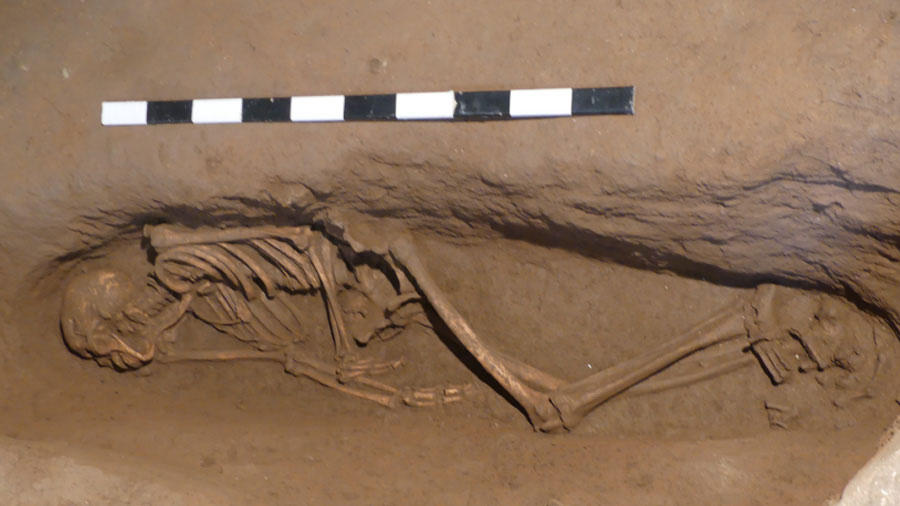
A research team led by the UAB and the UCM have conducted the first genetic study of the remains of the 8th century Islamic necropolis of Galligants, yielding the first biological data on the arrival of the first Islamic wave in Girona. The results confirm the geographical diversity of these early Muslims and their family ties, as well as a pattern with the presence of children but the absence of women in the necropolis.
The study was led by lecturer Cláudia Gomes, from the Complutense University of Madrid (UCM), and Eulàlia Subirà, from the Universitat Autònoma de Barcelona (UAB), and included the collaboration of the Cayetano Heredia University (UPCH), Peru, and the Archaeological and Paleontological Heritage Service of the Government of Catalonia.
The analysis revealed a surprising biogeographic diversity, with origins ranging from the Islamic world and North Africa to Europe. This genetic information also allowed discovering family ties between the individuals buried, suggesting that the burial was not random, but rather responded to a social or family logic. Among the most notable findings is the case of an individual of European origin who could correspond to a possible case of a European convert to Islam.
The study also shows a peculiar demographic pattern, since half of the individuals belonged to six-week-old babies. There was a notable absence of adult women, which led researchers to propose several hypotheses. Among others, the possibility of a higher mortality rate between men and children was considered, or the existence of a cultural or religious practice with a different location for female burials. This peculiar distribution motivated the researchers to rethink the reasons for the Islamic migration to Girona: it may not have been driven only by war or for reasons of conquest, but also by social causes, such as the search for better living conditions.
The study represents a significant advance in the archaeology and genetics of the region, since it is the first to carry out a biological and genetic analysis on a medieval Islamic community in the north of the Iberian Peninsula. While similar genetic studies have been carried out in the south of the Peninsula, in areas such as Al-Andalus, there is limited biological data on Islamic population movements in Catalonia and other regions of northern Spain. The researchers consider that these results offer a new perspective on the past, with both scientific and social implications, because they invite us to reconsider traditional accounts of the Islamic conquest, which have historically focused on a warlike approach and religious imposition.
The multidisciplinary analysis on which the study was based was carried out in the fields of archaeology, anthropology and genetics. The archaeological work was led by Maribel Fuertes (Archaeological and Paleontological Heritage Service of the Government of Catalonia), while the analysis of anthropological data was led by Eulàlia Subirà, from the Department of Animal Biology, Plant Biology and Ecology of the UAB. The genetic phase, which lasted almost two years, was carried out at the Laboratory of Forensic Genetics and Population Genetics of the Complutense University of Madrid.
The results of this research not only enrich our knowledge of the history of Islamic migration to Catalonia, but also open up new lines of research. Future studies of other necropolises from the period will allow for a better understanding of the patterns of population movements and the cultural and social contexts of the first Islamic groups in the Iberian Peninsula.
Reference article: Gomes, C., Fuertes, M., Palomo-Díez, S., López Matayoshi, C., Lopez Parra, A. M., Labajo González, E., … Subirà, M. E. (2025). A multidisciplinary investigation on the collective identity and social perspective of a medieval Islamic necropolis (eighth–tenth centuries) in Girona (modern Spain). Mediterranean Historical Review, 40(2), 117–140. https://doi.org/10.1080/09518967.2025.2569018
 NOTES
NOTES