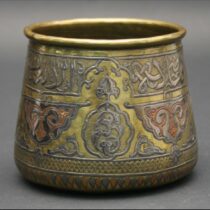
The city of St. Augustine, Florida, has the distinction of being continuously occupied longer than any other European settlement in what is today the continental United States. A large portion of the city’s physical history, including more than a million artifacts, is curated at the Florida Museum of Natural History.
Now, that history is making its way online. With funding from the National Endowment for the Humanities, the Florida Museum has launched Interactive Digital St. Augustine, or iDigStAug, an online database dedicated exclusively to the archaeology of colonial household sites in St. Augustine.
“We have a large collection from colonial house sites in St. Augustine, most of which were done under the direction of Kathleen Deagan and the Historic St. Augustine Preservation Board. We’ve started this new website to get the collections online in a way that allows both researchers and the general public to view it,” said Gifford Waters, collection manager for historical archaeology at the Florida Museum.
Though well-established now, St. Augustine has come close to falling off the map on more than one occasion throughout its long history. Its first few hundred years were especially tumultuous.
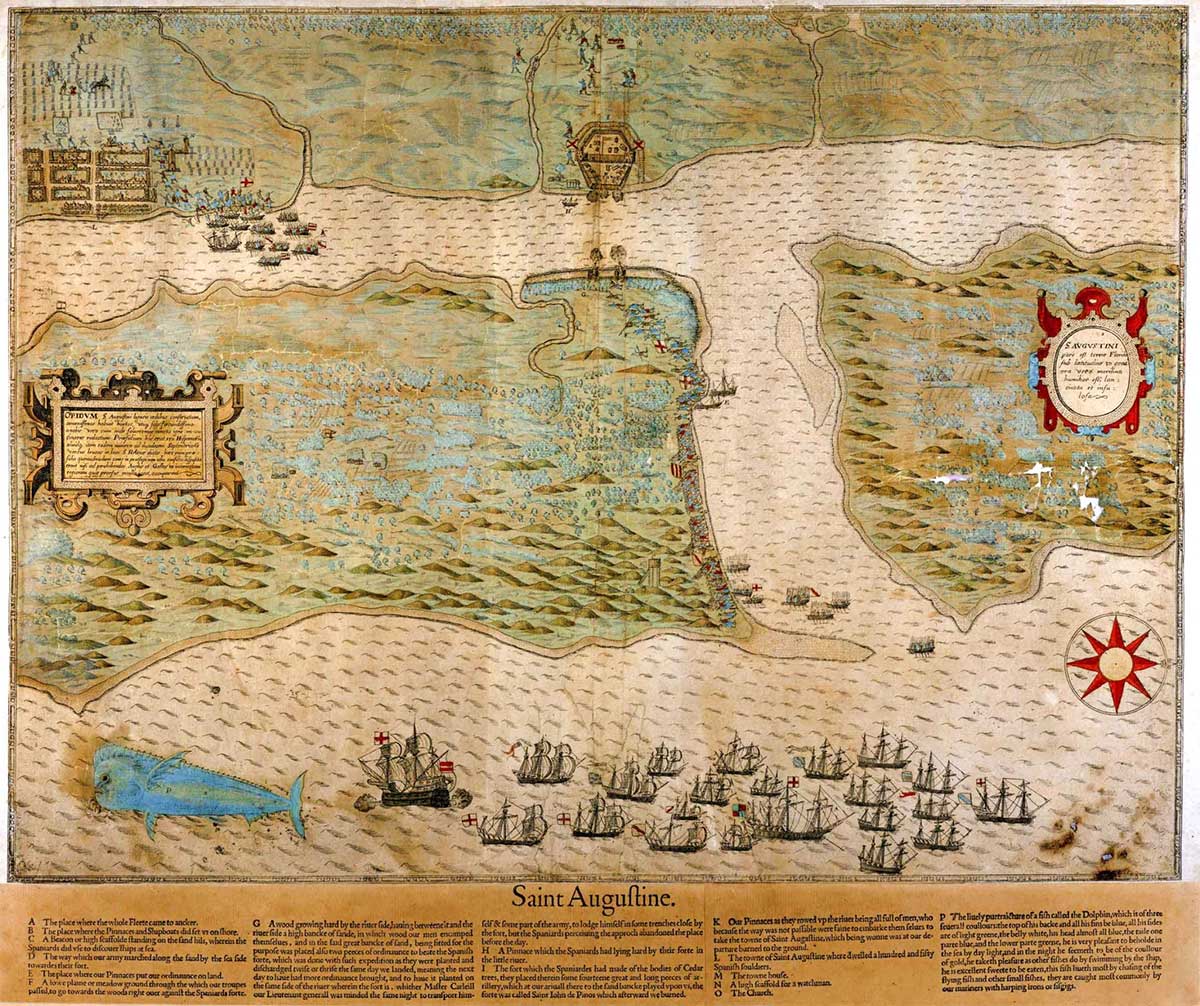
Less than a year after it was founded by the Spanish in 1565, St. Augustine was relocated from the mainland to Anastasia Island due to conflict with the Indigenous Timucua, whose village the Spanish were living in. It was relocated again in 1572 after it was partially destroyed by a mutiny and heavy erosion threatened to wash what was left into the sea. It was burned to the ground by pirates in 1586, accidentally burned down by its inhabitants then flooded by a hurricane in 1599, ransacked by pirates in 1668, burned to the ground by British settlers in 1702, and besieged by the governor of Georgia in 1740.
Throughout the 20th century, St. Augustine became increasingly threatened by a different type of erasure. According to the U.S. Census Bureau, St. Johns County, in which St. Augustine is located, had a population of 9,165 in the year 1900. Within the next 60 years, that number had jumped by more than 30,000, and by the turn of the twentieth century, its population had swelled to 123,135. Urban development kept pace with the influx of people, and what had been the backwater town of St. Augustine transformed into a lively city whose historic sites were in danger of being forgotten and paved over.
In response, the state of Florida passed a law in 1959 that established the Historic St. Augustine Preservation Board, tasked with acquiring and restoring dilapidated or destroyed houses from the city’s colonial era. For the next 38 years — until it was disbanded in 1997 — the board worked with archaeologists, historians and architectural historians to carefully excavate these sites and build faithful reconstructions of the houses that once stood there.
Much of the Florida Museum’s historical archaeology collection was recovered during this productive period of time. Because the work spanned several decades, archaeologists often went back to the same sites multiple times. This ensured that the surveys they conducted were comprehensive, but it also resulted in methodological inconsistencies. The difference, though trivial, adds up to a significant amount of variation in the collection data that has to be homogenized before it can make its way online.
“It’s a very long process,” Waters said. “The records don’t always match up in terms of how things were mapped and measured. So we have to go back and reanalyze all of these collections, looking at the measurements, counts, weights and descriptions of every single artifact.”
Because of this bottleneck, the iDigStAug website currently has information for three colonial houses, representing some 51,000 artifacts. This is a drop in the pail compared with the amount of data that will eventually be available on the site. Ultimately, nearly everything from St. Augustine — from the smallest bead made by Native Americans to a trove of British contraband found in the ruins of a harbormaster’s house — will be easily accessible to the public.
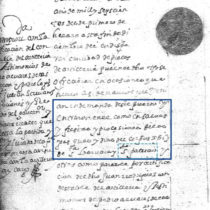
The database also includes historical summaries of each site and archaeological reports with details regarding when and where excavations took place and who they were led by, the artifacts that were recovered, photographs, slides, handwritten field notes, and diagrams that depict how the structures were laid out.
“What makes iDigStAug really unique is we’ve scanned and digitized all the field records, maps and analysis cards and uploaded them as archival PDFs that are freely available to researchers and the general public,” Waters said.
Users can also access high-resolution, hand-drawn maps of St. Augustine as it looked through the colonial ages.
Those interested in a particular type of artifact or data type can specify what they’re looking for using the website’s query function. “You can pick which category you’re interested in, things like beads or Spanish pottery or Native American ceramics, and immediately find simplified information about what was found at each site or all of the sites.”
Information being only as good as the way in which it’s used, archaeologists and educators at the museum are also working with the Florida Public Archaeology Network to develop educational resources for students.
iDigStAug and its sister site, the Comparative Mission Archaeology Portal (CMAP), were both developed in partnership with the Digital Archaeological Archive of Comparative Slavery at Monticello.
 NOTES
NOTES