Rare architecture and artifacts date to the Postclassic period when Maya urban centers were undergoing significant societal and environmental challenges.
Past civilizations have been significantly affected by climate change, but how they adapted to new conditions centuries ago is less clear.
In newly published research, a team of archaeologists and geographers describes a new excavation at the Birds of Paradise wetland field complex in northwestern Belize—one that provides insight into how the Maya civilization responded to both societal and environmental change from the years 800 to 1500.
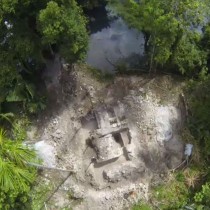
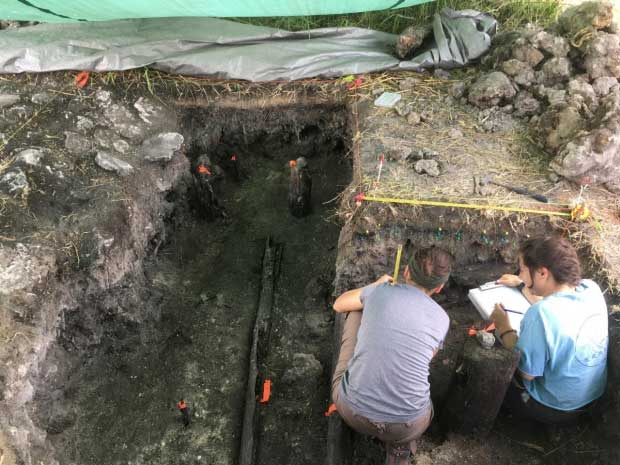
Stemming from over 20 years of on-the-ground research of the Lowland Maya region, this study uncovered the largest collection of architectural wood found inland, along with artifacts that provide insight into Maya subsistence in the wetlands during a period when nearby urban centers had been abandoned.
“Our most exciting finding is the remarkable preservation of wooden architecture in a tropical wetland,” says Lara Sánchez-Morales, an assistant professor of anthropology at New York University and the lead author of the paper, which appears in the journal Proceedings of the National Academy of Sciences.
Sánchez-Morales and her colleagues, who included Timothy Beach, a professor of geography and the environment at The University of Texas at Austin, relied on multiple methods, including lidar mapping—a remote sensing technique that uses pulsed laser to generate three-dimensional images—to locate these features over this intricately human-constructed landscape.
The authors add that the most important method was the systematic excavation, which allowed the team to reconstruct the timing and phases of construction of the settlement.
“The discovery challenges the long-held assumption that sites like this could not survive in the American tropics, and it suggests we might be overlooking similar places,” adds Sánchez-Morales, who began this research as a doctoral student at UT Austin and will continue to expand it as part of her research program at NYU’s Department of Anthropology. “It’s a reminder that the archaeological record of these environments is richer than we once thought, and it pushes us to rethink how we search for and interpret settlements in the American tropics.”
The paper’s authors note that wetlands provided hunting and fishing resources to ancient populations, while also serving as a refuge during periods of drought and societal upheaval. However, they add, the rapid decay of organic artifacts can make ancient settlements in tropical wetlands difficult to study.
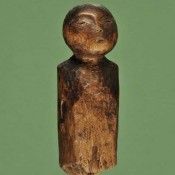
The settlement included eight earthen mounds, which were likely structure pads for buildings, and a large, raised platform constructed of limestone. A wide variety of scattered ceramic and lithic artifacts and faunal remains were excavated at the site along with 10 well-preserved wooden posts, likely representing the site’s structural foundations.
“Together, these reveal a highly adaptable community with diverse tools, foods, and building materials,” says Beach. “This shows us that Maya communities could shift habitats and persist through climate extremes, but we still don’t know how large this wetland population was or how it functioned. Our next steps include expanding excavations to understand how the Maya built with rare woods, how they fed themselves, and how this wetland settlement fit into a region undergoing widespread abandonment.”
 NOTES
NOTES