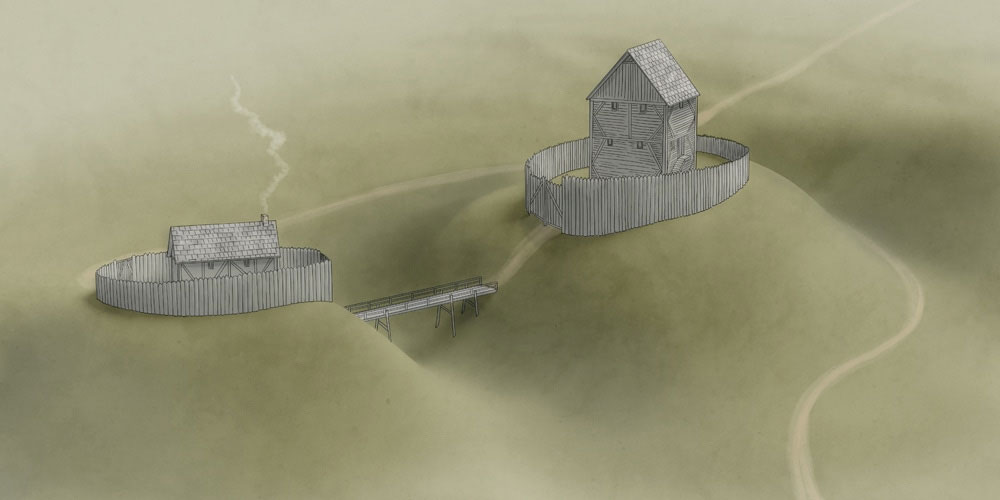
Recently, an archaeology enthusiast reported an unusual land formation in the Töbeli area near Uesslingen-Buch, Switzerland. The prospection which followed showed traces of a castle dating to the 10th-11th c. The discovery of the castle at the Töbeli site is of great historical importance.
Heinz Moll from Ittigen in the canton of Bern was recently scrolling through a LIDAR relief map of the canton of Thurgau on his computer. Being an enthusiastic researcher of castles, he was looking for extraordinary terrain formations. On the elevation model he noticed two small plateaus in the Töbeli area surrounded by steep ditches. He also identified several sunken roads. Both are typical features of so-called mottes (mounds) or earthworks, suggesting an early form of medieval castles. Moll immediately reported his observations to the Office for Archaeology of the Canton of Thurgau. The volunteer researcher Adrian Schoch then carried out an officially approved survey. After a five-hour search with his metal detector, he provided the crucial pieces of evidence: in addition to a small ceramic shard, he found several iron objects – including three medieval projectile points, which based on their shape are dated to the 11th or 12th century.
A discovery of great historical significance
The discovery of the castle site in the Töbeli area is of great historical significance. The site is located near Kartause Ittingen. According to historical sources, this original Augustinian monastery monasterzwas built on the site of the castle of the Lords of Ittingen. But where exactly was this castle located in the 11th and 12th centuries?
A document from 1079 mentions a military conflict between Abbot Eckehard II of Reichenau and Abbot Ulrich III of St. Gallen, during which the Castle of Ittingen was said to have been razed to the ground by iron and fire. Thus, the castle of the Lords of Ittingen was destroyed in 1079. Later documents confirm that it was rebuilt. But where? On that, the sources are silent.
When sources fall silent, archaeology often finds an answer. For this reason, researchers have been searching for traces in the terrain for over a hundred years. There are now three possible locations where the ancestral seat of the Lords of Ittingen might have stood. One castle site is in the Chrüzbuck area in the municipality of Warth-Weiningen, about 350 meters south of the newly discovered Töbeli site. Some historians believe the ancestral castle was located within Kartause Ittingen itself, referring directly to a document from Pope Eugene III from 1152, in which the brothers Albert, Berchtold, and Ulrich of Ittingen were granted permission to build a monastery on their castle in Ittingen.
The castle was directly connected to the regional road network
Today, the Chrüzbuck and Töbeli castle sites are no longer situated along any major traffic routes. However, in the Middle Ages, a hollow way led from Töbeli directly down to the Chrüzbuck site. There, an east-west route ran along the northern terrace of the Thur river. This stretch connected two river crossings – one near Uesslingen and another southeast of Kartause Ittingen. The newly discovered castle was thus directly connected to the regional road network – and may even have been located on a long-distance route between Winterthur and Constance.
Based on comparable sites, it is possible to estimate what the castle at Töbeli might have looked like: a multi-story wooden tower, protected by a palisade and deep defensive ditches.
The Office for Archaeology of Thurgau will not carry out excavations on the two newly discovered castle plateaus. Any potential structures and finds will remain in the ground to be preserved for future research. The artifacts recovered by Adrian Schoch are currently being conserved and restored at the Office for Archaeology.
 NOTES
NOTES