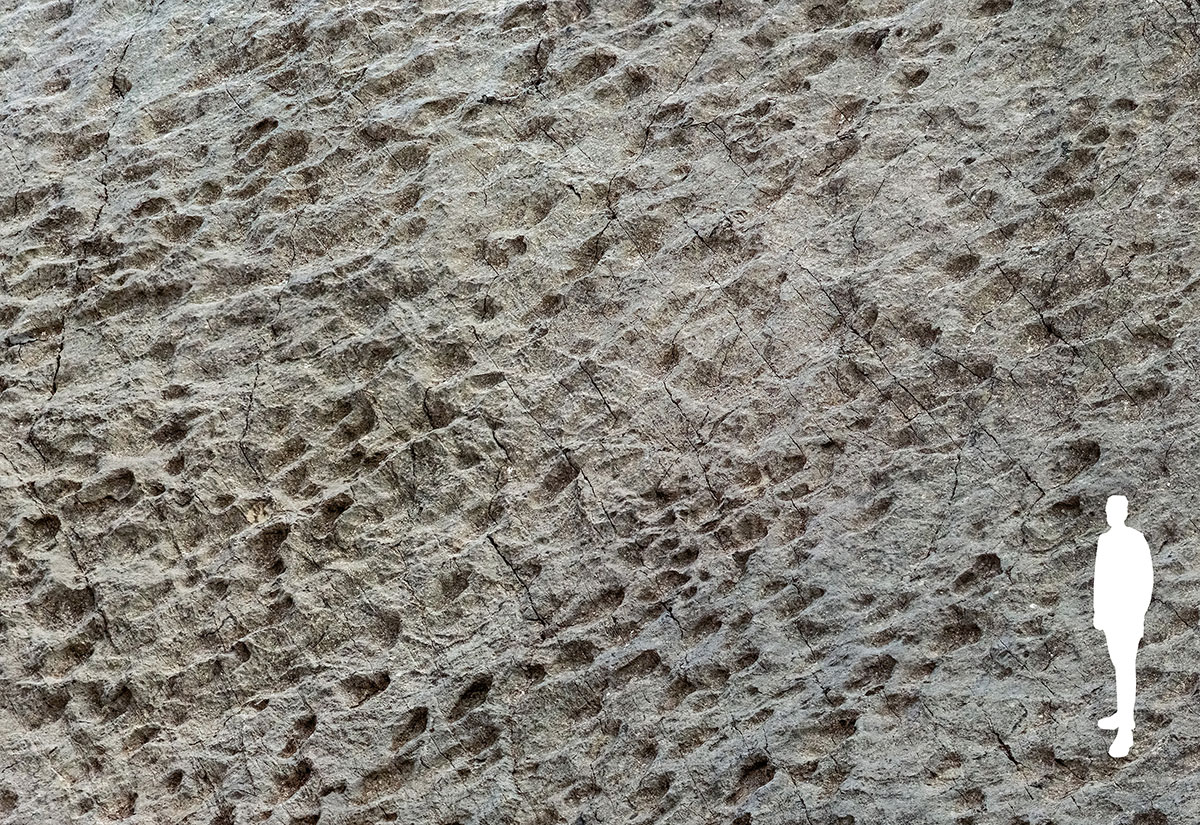
Herds of large herbivores formed them about 210 million years ago, during the Late Triassic. The “valley of the dinosaurs” extends for kilometers: it is the largest site in the Alps and one of the richest in the world. Never before reported or studied, it will engage geologists and paleontologists for decades. A collaboration between agencies will ensure its protection, study, and promotion.
In the heart of the Alps, in the Fraele Valley, between Livigno and Bormio—places that will host the next Milan-Cortina Olympics—prehistory has provided an unexpected and extraordinary gift. Last September, a nature photographer spotted hundreds of meters of dinosaur tracks on extensive, nearly vertical dolomite walls, evidence of a past that dates back over 200 million years. The tracks, preserved in excellent condition despite the altitude, show traces of toes and claws imprinted on the walls when they were tidal flats at the end of the Triassic.
On the same day, news of this exceptional discovery was communicated to the Superintendency of Archaeology, Fine Arts, and Landscape for the provinces of Como, Lecco, Sondrio, and Varese, responsible for the protection of paleontological heritage. The Superintendency, in turn, informed the Directorate of the Stelvio National Park, where the finds lie. The area is not accessible by trails, so drones and remote sensing technologies will be used to study them. Photos, geo-paleontological evidence, and videos produced by the Carabinieri Unit of the Stelvio National Park in Valdidentro were presented at a press conference on December 16, 2025.
According to analyses by the Natural History Museum of Milan, conducted in collaboration with the MUSE of Trento and the “Ardito Desio” Department of Earth Sciences of the University of Milan, on behalf of the Superintendency of Archaeology, Fine Arts and Landscape for the provinces of Como, Lecco, Sondrio and Varese, and in agreement with the Stelvio National Park, this represents one of the most important deposits of Triassic trace fossils in the world.
Analysis of geological maps and recent publications indicates that the footprints are preserved in dolomitic rocks from the Late Triassic, dating back approximately 210 million years. In the Eastern Alps, including the Dolomites, several sites with footprints of the same geological age are known, but these turn out to be the first dinosaur footprints discovered in Lombardy and the only ones exposed north of one of the most important faults in the Alps, the Insubric Line.
 NOTES
NOTES