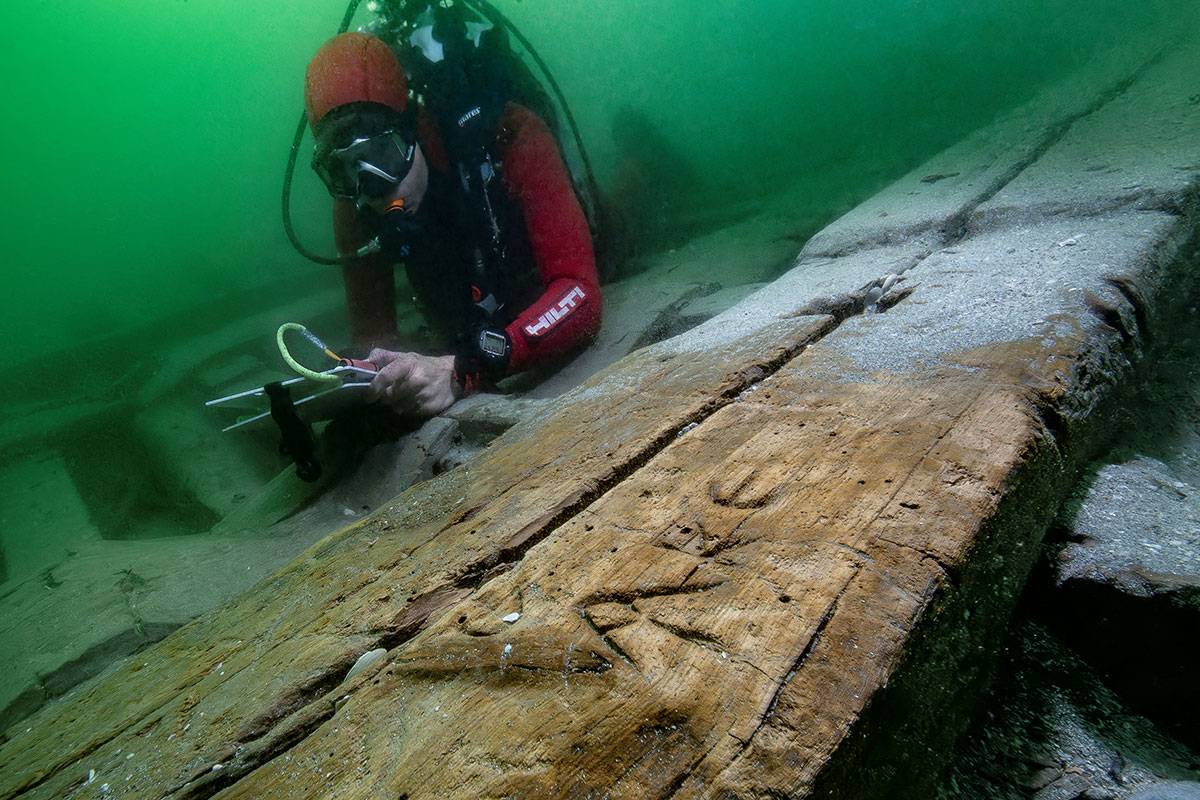
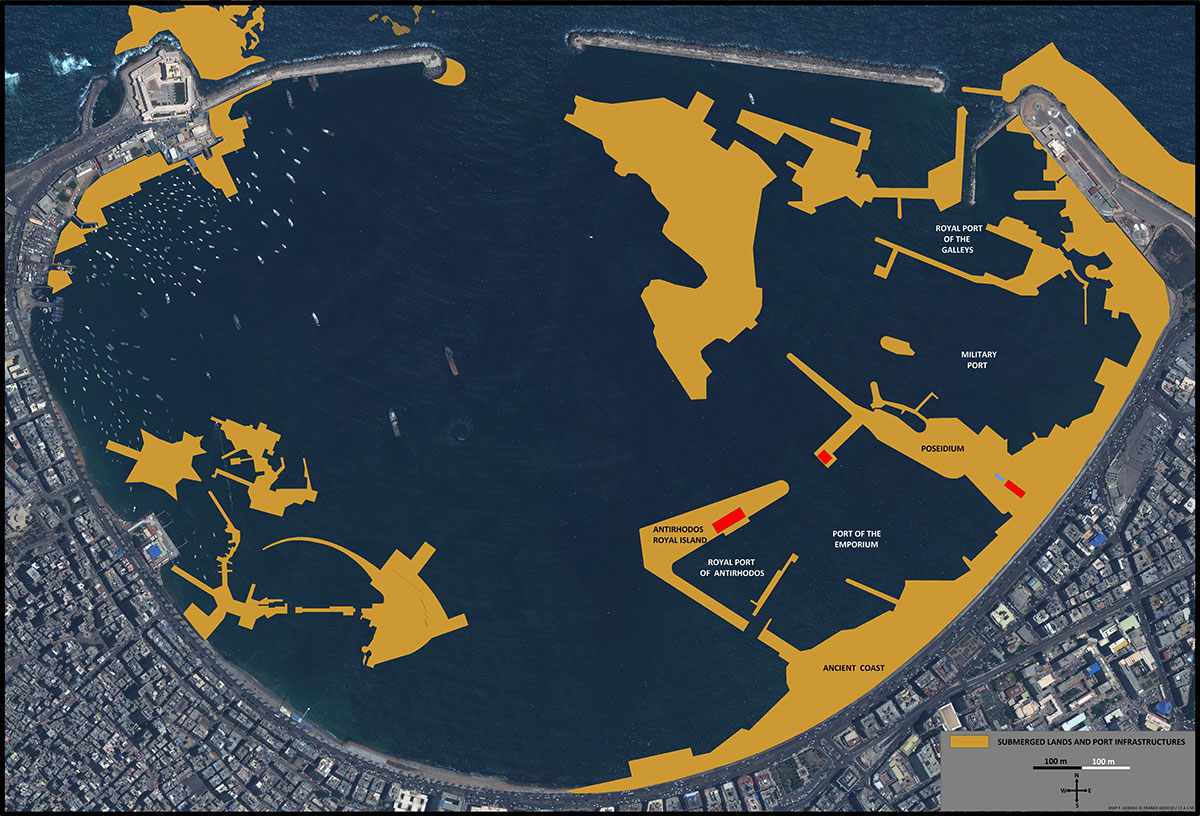
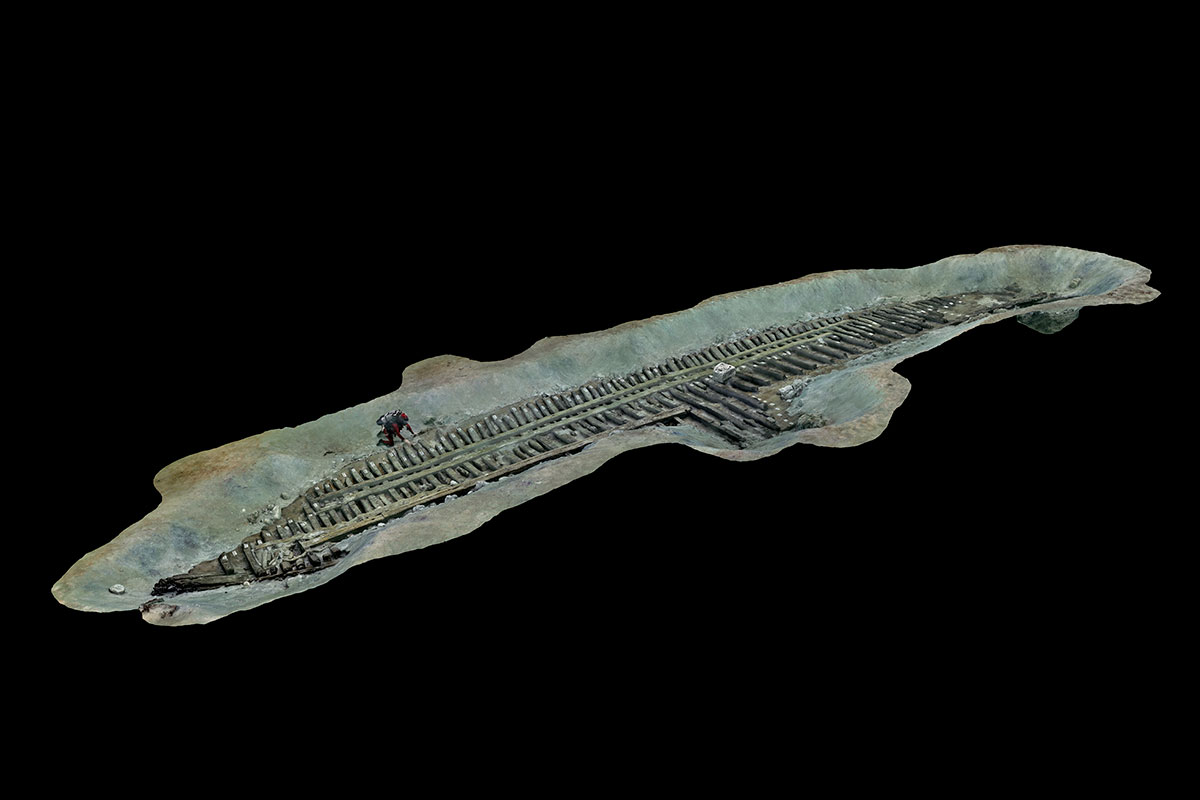

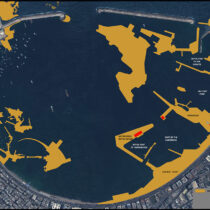
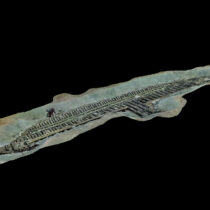
In the Port of the Royal Island of Antirhodos, in the great Portus Magnus of Alexandria, now totally submerged, excavations by the Institut Européen d’Archéologie Sous-Marine (IEASM) under the direction of Franck Goddio, have revealed, for the first time ever, the well-preserved timbers of a shipwreck that was one of Egypt’s famous ancient pleasure barges (thalamagos).
The discovered 28 metres long preserved timbers correspond to a boat of 35 metres in length with a breadth of around 7 metres. Its construction type was to obtain a maximum breadth for the ship to accommodate a central pavilion. The particularity of the ship is the flat-bottomed hull with a hard chine at the bow and a rounded turn at the stern. Graffiti in Greek, found on the central carling, can be dated to the first half of the 1st century AD. They reinforce the hypothesis that the ship was built in Alexandria; she would have had a luxuriously decorated cabin and seems to have been propelled only by oars.
The ancient author Strabo, who visited Alexandria around 29-25 BC, saw how they were used: “…they hold feasts in cabin-boats (thalamagoi), in which they enter the thick of the cyami and the shade of the leaves.” (Geography XVII.1.15)
Franck Goddio puts forward a hypothesis concerning this wreck: “This intriguing shipwreck could have been used along the canals in Alexandria as Strabo described, but as it was also found very close to our excavations on the temple of Isis on Antirhodos Island (see map of the Portus Magnus), it could well have sunk during the catastrophic destruction of this temple around 50 AD (taking into account its dating). We might thus also suggest a ritual use for this barge – it could have belonged to the sanctuary and be part of the naval ceremony of the navigatio iside when a procession celebrating Isis encountered a richly decorated vessel-the Navigium- which embodied the solar barque of Isis, mistress of the sea. This vessel was performing a yearly ritual voyage of the goddess from the Portus Magnus of Alexandria to the sanctuary of Osiris at Canopus alongside the Canopic Channel.”
Although research on the wreck is still at an early stage, it promises to be a fascinating journey into life, religion, luxury and pleasure on the waterways of early Roman Egypt. A representation of a small thalamagos, set within a Nilotic rivers cape can be seen, with
noble men hunting hippopotamus, on the Nile mosaic of Palestrina in the bottom left corner.
Thalamagoi: The most well-known of these pleasure barges were the gigantic floating palaces of the Ptolemies; including Cleopatra VII’s which she used to show Julius Caesar the sights of Egypt in the spring of 47 BC.
The scientific results of the excavations on the temple of Isis in Alexandria’s Portus Magnus have recently been published by the Oxford Centre for Maritime Archaeology:
https://www.franckgoddio.org/service/newsletter/detail/new-publication-1/
European Institute for Underwater Archaeology (IEASM)
The IEASM was founded in 1987 as a French non-profit organization by its President Franck Goddio. Its aim is the location, exploration, excavation and restoration of sunken sites. IEASM calls upon scientists and specialists from different scientific fields to support its research missions and to study and publish their findings. Furthermore, it sets up exhibitions allowing the general public to get access to its discoveries.
IEASM: www.ieasm.org
Franck Goddio: www.franckgoddio.org
Franck Goddio’s YouTube Channel: www.youtube.com/@Franck_Goddio
The Hilti Foundation
The Hilti Foundation is a philanthropic impact organization based in Liechtenstein, operating globally as well as in Liechtenstein and the surrounding region. Its mission is to empower people in need to lead self-determined lives and to make a positive contribution to critical environmental issues. The Foundation is strongly committed to creating lasting, positive social impact through long-term initiatives and strategic partnerships.
Since 1996, the Hilti Foundation has supported the work of Franck Goddio and the IEASM, contributing to innovation in underwater archaeological research and making these discoveries accessible to the scientific community and the general public. www.hiltifoundation.org
 NOTES
NOTES