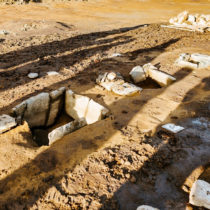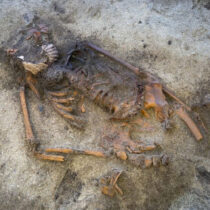

Researchers are now investigating a Viking Age grave with preserved skeletal remains and jewellery. The grave was found at Val in Bjugn, in Trøndelag County. A discovery by a metal detectorist alerted researchers to the find.
Earlier this year, Roy Søreng was out with a metal detector in Bjugn in Trøndelag County when he came across an oval brooch, a piece of jewellery typical of the Viking Age and the centuries before.
Archaeologists from the NTNU University Museum and Trøndelag County Council have now become involved in investigating the find. The Norwegian Directorate for Cultural Heritage has also taken an interest.
“The Viking Age grave contains what we believe to be a woman, buried with a typical Viking Age costume and jewellery set from the 800s. This indicates that she was a free and probably married woman, perhaps the mistress of the farm,” says Raymond Sauvage, head engineer at the museum’s Department of Archaeology and Cultural History.
The archaeologists have been digging in secret because the find is so beautiful. They praise both the finder Søreng and landowner Arve Innstrand for their help.
The jewellery consists of two oval brooches that attach to the straps of a suspender dress, as well as a small ring buckle that closed the neck opening of a petticoat. Søreng’s find earlier this year was one of the oval brooches.
Found another skeleton in the same field
“The most remarkable thing is two scallop shells placed at the dead woman’s mouth. This is a practice that is not previously known from pre-Christian graves in Norway. We don’t yet know what the symbolism means,” says Sauvage, who is also the project manager for the surveys.
The shells lay with the curved side out and the straight edge up, so that they partially covered the mouth. The researchers also found small bird bones along the grave, probably from wings.
Earlier this year, the researchers documented an exceptionally well-preserved skeleton on the same field as this new find. That skeleton was from the 700s. But Søreng’s metal detector find encouraged them to check out the new place as well.
Could have been destroyed if it weren’t for the landowner
“During the inspection, we quickly realized that we were facing a new skeletal grave that was in acute danger of being damaged during the next ploughing,” says field supervisor Hanne Bryn, from the Department of Archaeology and Cultural History.
But instead, landowner Innstrand decided to allow the researchers to continue to work on the grave.
“This new grave is probably one to three generations younger than the previously documented grave at the site,” says Bryn.
The Norwegian Directorate for Cultural Heritage allocated extra money to the project to secure the find and preserve as much information as possible. Those funds have meant archaeologists could carry out a so-called security excavation. They were thus able to document both the skeletal remains and the grave goods.
“This is an incredibly exciting finding. It is very unusual to find such a well-preserved skeleton in ancient graves. This find has great cultural heritage value and potential. Therefore, it was important for the Directorate for Cultural Heritage to provide funds to ensure this could be studied in the best possible way,” said Hanna Geiran, director general of the Norwegian Directorate for Cultural Heritage.
“I would like to commend both the landowner and the finder for now being able to learn a little more about a fascinating period in our common history. The Viking Age engages many people, and now we look forward to learning more after the further investigations at the NTNU University Museum,” said Geiran.
DNA can show whether they were related
The archaeologists waited until now to publish the information about the skeleton and the objects in the Viking Age grave, simply because the work of preserving it was difficult, and for other practical and professional reasons.
People at the NTNU University Museum will now analyze the find from the Viking Age grave.
“We will examine the skeleton, preserve the objects and take samples for dating and DNA analysis. The goal is to learn more about the person and about possible kinship to the previous find from the same place,” says Sauvage.
The researchers will look for more information about body height, gender-determining traits and any evidence of disease.
 NOTES
NOTES