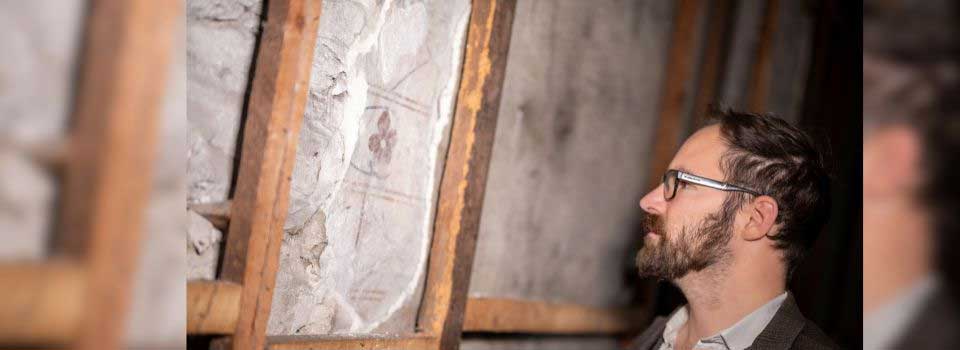
A hidden section of medieval wall painting, not seen for hundreds of years, is giving clues to the grand past of Durham Castle.
Revealed during renovations, the artwork is of an outlined masonry pattern with a central flower and stem motif.
The painting is thought to date from the late 13th to early 14th centuries – approximately 750 to 700 years ago.
It tells us more about the high status of Durham Castle – part of the City’s UNESCO World Heritage Site alongside Durham Cathedral.
Founded in 1072, the Castle was once the seat of the powerful Prince Bishops of Durham. Today it’s home to University College, with some of our students living there.
Academics and students from our departments of Archaeology and History, Durham Castle Research Group and our flagship Heritage 360 programme, plus staff from our Estates and Facilities team, worked on the find.
“The uncovering of this fragment of medieval wall painting is an absolutely sensational discovery. It’s an incredibly rare survival in such an important castle site and really underscores the power and status of the medieval bishops of Durham,” said Dr Andrew Ferrara (Project lead, Department of Archaeology).
Oyster shell “snack” recovered
The painting had been covered by later plasterwork and then 1950s wall panelling.
Alongside it, our team found extensive redecoration and alterations to the same part of the Castle, which is today known as the Senate Suite.
This included the blocking of windows, thought to date from the 1540s when Bishop Cuthbert Tunstall began building work to create a chapel.
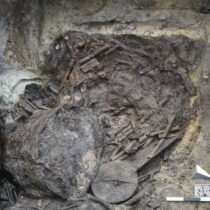
An oyster shell was found jammed into the infill, potentially representing a snack of one of the 16th century masons.
Other discoveries included evidence of the castle’s historic subsidence in the shape of a zigzagging crack across the stonework.
Archaeologists think this was early in the castle’s history as an angled buttress was added to the external north wall for additional support in the 13th or 14th century.
 NOTES
NOTES