Researchers at University of Tsukuba have demonstrated, through multi-agent simulations in a two-dimensional space, that the combination of environmental variability and human migration may foster the evolution of human cooperative behavior because their joint effect disrupts non-cooperative groups while facilitating the emergence of cooperative groups.
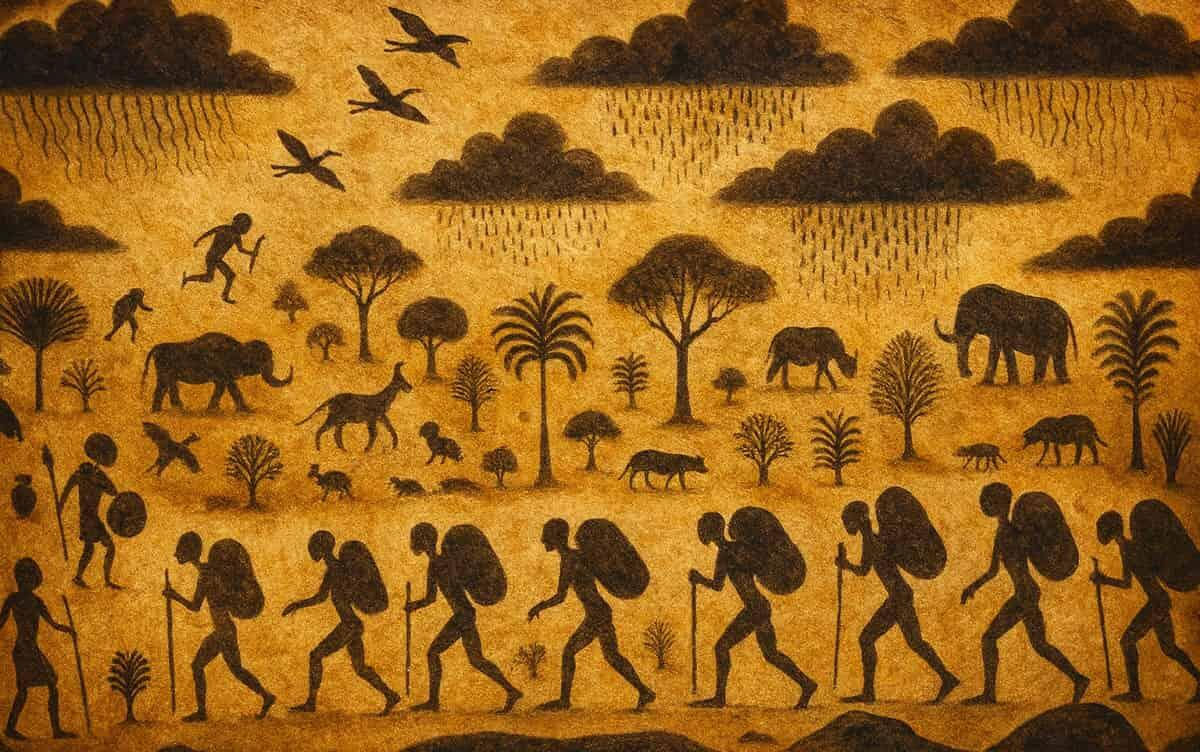
Cooperation is fundamental to human societies. Building on the hypothesis that heightened environmental variability in Africa during the Middle Stone Age influenced behavioral evolution, this study investigates the joint influence of environmental variability and human migration on the evolution of cooperation.
In their simulation model, the variability is represented as the random movement of resource-rich zones across a two-dimensional space, and the migration is represented by the resource-seeking migration of agents (e.g., humans). The agents interact cooperatively or competitively for resources and adopt their behavioral strategies by imitating neighbors with more resources.
The simulation results reveal that cooperation is more likely to evolve when environmental variability and mobility are sufficiently high. Moreover, the interactions between these factors hinders non-cooperative groups and encourages the formation of cooperative groups.
Unlike previous studies that examined environmental variability and migration separately, this study systematically analyzes their combined effects on the evolution of cooperation. Thus, it offers a novel perspective on how environmental dynamics and mobility may have shaped the evolution of human cooperation and, by extension, sociality.
 NOTES
NOTES